USANA supplement label
HealthPak: what's in each packet, and how it differs from CellSentials
Each HealthPak packet lists vitamins A through K and the B vitamins, 243 mg each of calcium and magnesium, trace minerals, and a complex with 125 mg of alpha-lipoic acid and 90 mg of quercetin. The label says to take one packet in the morning and one in the evening.[1] At two packets a day it provides 486 mg of magnesium and 40 mg of niacin, both above the adult upper limits for those nutrients from supplements.[2][3]
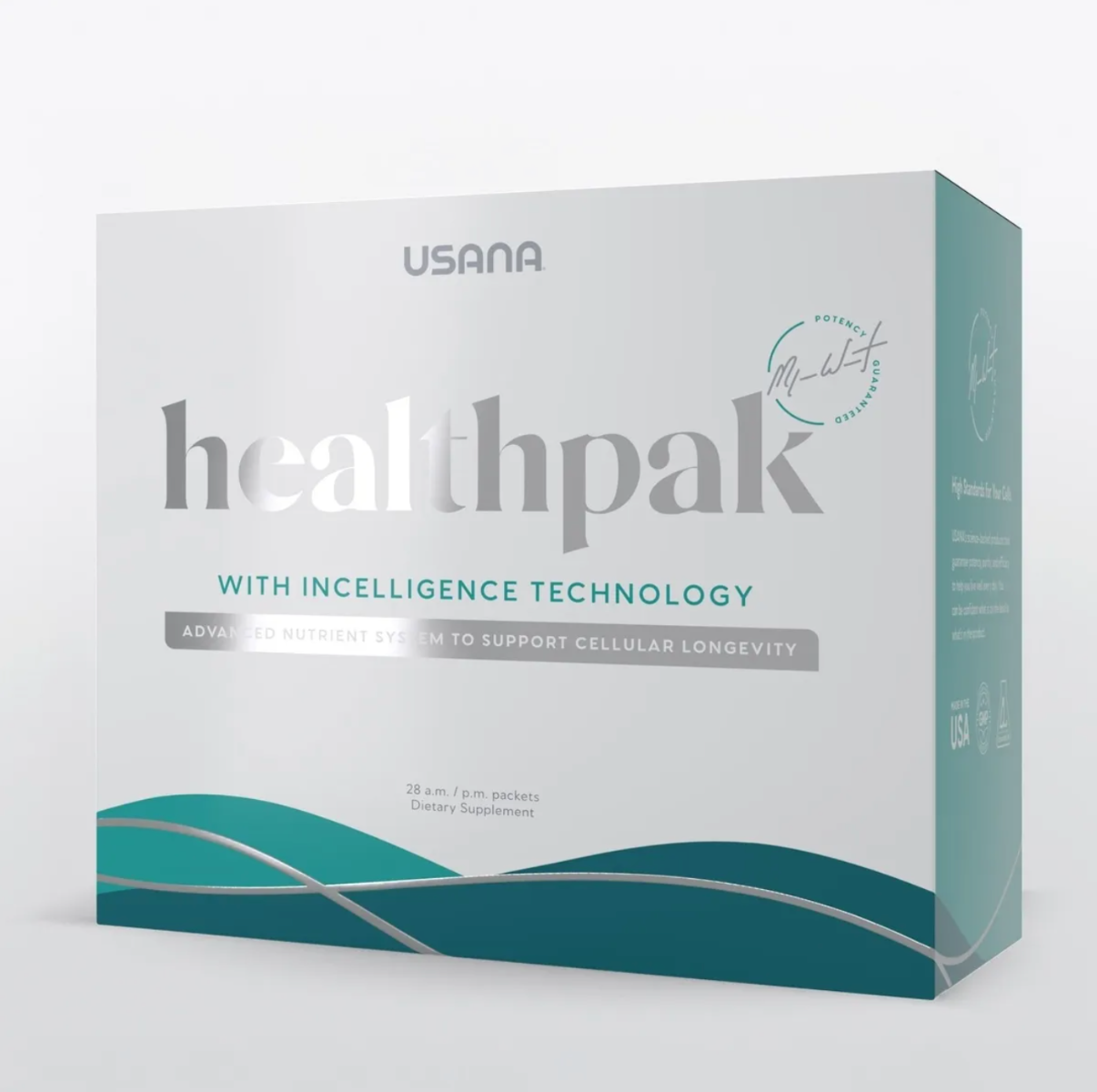
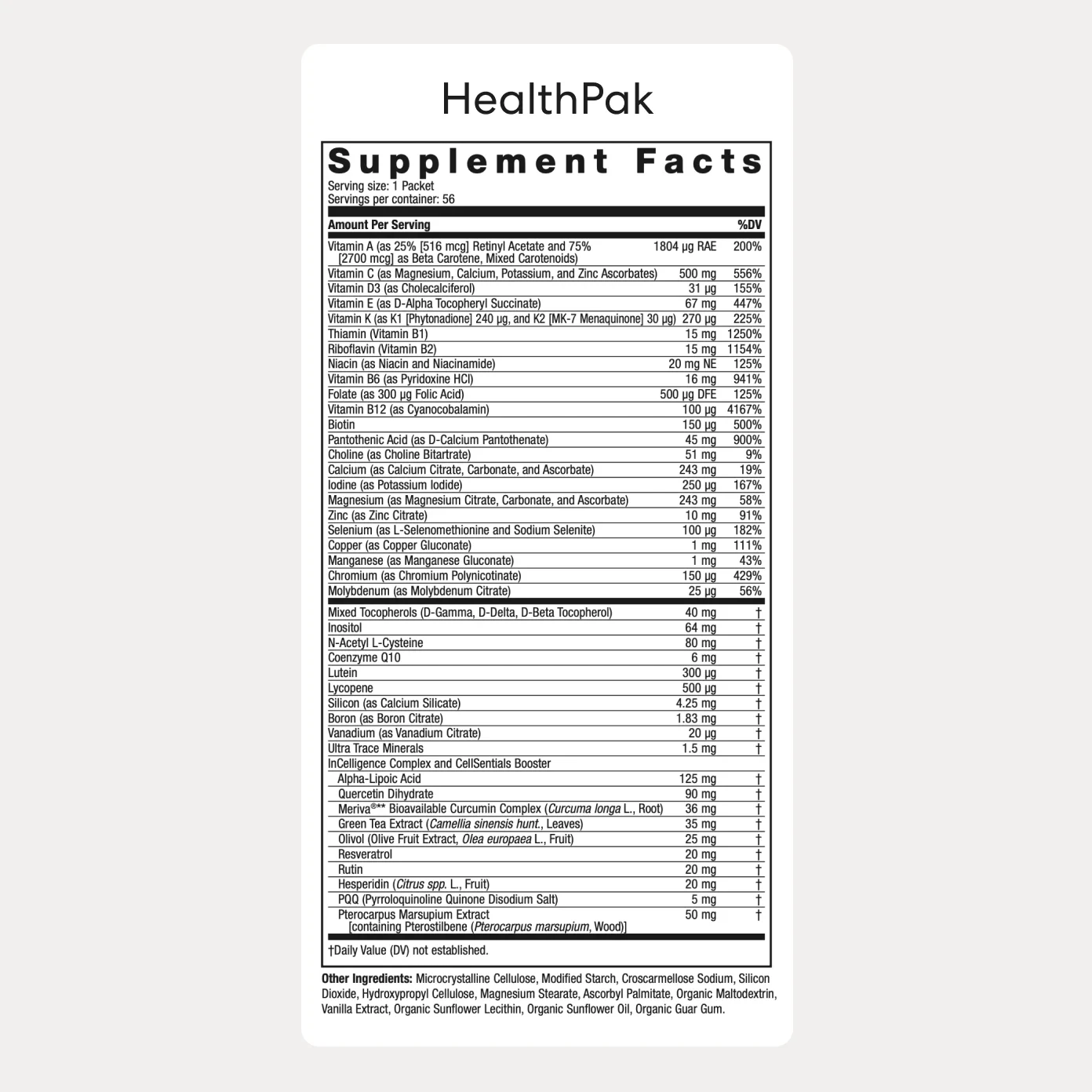
What is in HealthPak? The ingredient label, as text
Joy Health transcribed every row below and checked it against the U.S. label USANA publishes.[1] Amounts, units, and % Daily Values are exactly as printed. Formulas change, so compare the label on your own package.
Directions on the label: Take one (1) packet in the morning and one (1) packet in the evening, preferably with food.
| Ingredient | Amount per serving | % Daily Value |
|---|---|---|
| Vitamin A (as 25% [516 mcg] Retinyl Acetate and 75% [2700 mcg] as Beta Carotene, Mixed Carotenoids) | 1804 µg RAE | 200% |
| Vitamin C (as Magnesium, Calcium, Potassium, and Zinc Ascorbates) | 500 mg | 556% |
| Vitamin D3 (as Cholecalciferol) | 31 µg | 155% |
| Vitamin E (as D-Alpha Tocopheryl Succinate) | 67 mg | 447% |
| Vitamin K (as K1 [Phytonadione] 240 µg, and K2 [MK-7 Menaquinone] 30 µg) | 270 µg | 225% |
| Thiamin (Vitamin B1) | 15 mg | 1250% |
| Riboflavin (Vitamin B2) | 15 mg | 1154% |
| Niacin (as Niacin and Niacinamide) | 20 mg NE | 125% |
| Vitamin B6 (as Pyridoxine HCl) | 16 mg | 941% |
| Folate (as 300 µg Folic Acid) | 500 µg DFE | 125% |
| Vitamin B12 (as Cyanocobalamin) | 100 µg | 4167% |
| Biotin | 150 µg | 500% |
| Pantothenic Acid (as D-Calcium Pantothenate) | 45 mg | 900% |
| Choline (as Choline Bitartrate) | 51 mg | 9% |
| Calcium (as Calcium Citrate, Carbonate, and Ascorbate) | 243 mg | 19% |
| Iodine (as Potassium Iodide) | 250 µg | 167% |
| Magnesium (as Magnesium Citrate, Carbonate, and Ascorbate) | 243 mg | 58% |
| Zinc (as Zinc Citrate) | 10 mg | 91% |
| Selenium (as L-Selenomethionine and Sodium Selenite) | 100 µg | 182% |
| Copper (as Copper Gluconate) | 1 mg | 111% |
| Manganese (as Manganese Gluconate) | 1 mg | 43% |
| Chromium (as Chromium Polynicotinate) | 150 µg | 429% |
| Molybdenum (as Molybdenum Citrate) | 25 µg | 56% |
| Mixed Tocopherols (D-Gamma, D-Delta, D-Beta Tocopherol) | 40 mg | † |
| Inositol | 64 mg | † |
| N-Acetyl L-Cysteine | 80 mg | † |
| Coenzyme Q10 | 6 mg | † |
| Lutein | 300 µg | † |
| Lycopene | 500 µg | † |
| Silicon (as Calcium Silicate) | 4.25 mg | † |
| Boron (as Boron Citrate) | 1.83 mg | † |
| Vanadium (as Vanadium Citrate) | 20 µg | † |
| Ultra Trace Minerals | 1.5 mg | † |
| InCelligence Complex and CellSentials Booster | ||
| Alpha-Lipoic Acid | 125 mg | † |
| Quercetin Dihydrate | 90 mg | † |
| Meriva® Bioavailable Curcumin Complex (Curcuma longa L., Root) | 36 mg | † |
| Green Tea Extract (Camellia sinensis hunt., Leaves) | 35 mg | † |
| Olivol (Olive Fruit Extract, Olea europaea L., Fruit) | 25 mg | † |
| Resveratrol | 20 mg | † |
| Rutin | 20 mg | † |
| Hesperidin (Citrus spp. L., Fruit) | 20 mg | † |
| PQQ (Pyrroloquinoline Quinone Disodium Salt) | 5 mg | † |
| Pterocarpus Marsupium Extract (containing Pterostilbene (Pterocarpus marsupium, Wood)) | 50 mg | † |
†Daily Value (DV) not established.
Other ingredients: Microcrystalline Cellulose, Modified Starch, Croscarmellose Sodium, Silicon Dioxide, Hydroxypropyl Cellulose, Magnesium Stearate, Ascorbyl Palmitate, Organic Maltodextrin, Vanilla Extract, Organic Sunflower Lecithin, Organic Sunflower Oil, Organic Guar Gum.
Comparing the labels, almost every vitamin and mineral row in a packet equals one serving of CellSentials plus one MagneCal D tablet, which is half a MagneCal D serving. Silicon is the exception, at 4.25 mg against CellSentials' 2 mg. The complex adds more alpha-lipoic acid (125 mg) and quercetin (90 mg) than CellSentials, plus a Pterocarpus marsupium extract.[1] This comparison is Joy Health's reading of the two labels.
The current label, item 100.010105, is the one transcribed here and shown in the photo. Compared with the previous label, item 100.010104, which Joy Health read from an earlier label photo, it raises alpha-lipoic acid from 63 to 125 mg and quercetin from 78 to 90 mg, lowers the Meriva curcumin complex from 58 to 36 mg, drops astaxanthin, and adds 50 mg of Pterocarpus marsupium extract. The vitamins, minerals, and directions did not change.[1]
How much does HealthPak add up to in a day?
Two packets a day provide 486 mg of magnesium, 136 mg above the adult upper limit of 350 mg. That limit counts only magnesium from supplements and medications, not food, so the comparison holds whatever you eat. NIH notes that high doses of magnesium from supplements often cause diarrhea, sometimes with nausea and abdominal cramping, and that the risk of magnesium toxicity rises when kidney function is impaired.[2]
Niacin comes to 40 mg a day against a 35 mg upper limit for supplemental niacin that is based on skin flushing, which NIH describes as unpleasant rather than toxic.[3] The CellSentials page explains why the label alone cannot tell you how likely that flushing is.
Food changes the picture differently for the two nutrients. Most U.S. adults already get more niacin from food than the recommended 16 mg NE a day for men or 14 mg NE for women; only 1% fall below the Estimated Average Requirement from food alone.[3] Magnesium is the reverse: many people in the United States consume less than the recommended 400 to 420 mg a day for men or 310 to 320 mg for women. Neither upper limit counts what food provides, and magnesium from food does not pose a risk in healthy people because the kidneys eliminate the excess.[2][3]
Joy Health interpretation: the label's directions are the manufacturer's, not a minimum. One packet a day instead of two provides 20 mg of niacin and 243 mg of magnesium, both under their limits, and halves everything else in the packet. That is a reasonable option for someone whose diet already supplies niacin and much of their magnesium, from foods such as green leafy vegetables, legumes, nuts, seeds, and whole grains.[2] A doctor, pharmacist, or registered dietitian can help match a supplement to what a diet already provides.
| Ingredient | HealthPak per day | Also in, per day | Adult UL |
|---|---|---|---|
| Vitamin A | 3,608 µg RAE (1,032 µg preformed) |
| 3,000 µg[4]Preformed vitamin A (retinol and retinyl esters) only; beta carotene is not counted |
| Vitamin C | 1,000 mg |
| 2,000 mg[5]Food and supplements |
| Vitamin D | 62 µg |
| 100 µg[6]Daily intake; ODS notes that toxicity almost always comes from supplements |
| Vitamin E | 134 mg |
| 1,000 mg[7]Supplemental alpha-tocopherol only |
| Vitamin K | 540 µg |
| None set[8]No UL set |
| Thiamin | 30 mg |
| None set[9]No UL set |
| Riboflavin | 30 mg |
| None set[10]No UL set |
| Niacin | 40 mg NEAbove the 35 mg UL by 5 mg |
| 35 mg[3]Supplemental niacin only, both forms; based on skin flushing |
| Vitamin B6 | 32 mg |
| 100 mg[11]Food and supplements |
| Folate | 1,000 µg DFE (600 µg as folic acid) |
| 1,000 µg[12]Folic acid from supplements and fortified foods only |
| Vitamin B12 | 200 µg |
| None set[13]No UL set |
| Biotin | 300 µg |
| None set[14]No UL set |
| Pantothenic acid | 90 mg |
| None set[15]No UL set |
| Choline | 102 mg |
| 3,500 mg[16]Food and supplements |
| Calcium | 486 mg |
| 2,500 mg (2,000 mg from age 51)[17]Daily intake; food alone rarely reaches it |
| Iodine | 500 µg |
| 1,100 µg[18]Food and supplements |
| Magnesium | 486 mgAbove the 350 mg UL by 136 mg |
| 350 mg[2]Supplements and medications only; magnesium in food is not counted |
| Zinc | 20 mg |
| 40 mg[19]Food and supplements |
| Selenium | 200 µg |
| 400 µg[20]Food and supplements |
| Copper | 2 mg |
| 10 mg[21]Food and supplements |
| Manganese | 2 mg |
| 11 mg[22]Food, water, and supplements |
| Chromium | 300 µg |
| None set[23]No UL set |
| Molybdenum | 50 µg |
| 2,000 µg[24]All sources |
| Mixed tocopherols | 80 mg |
| No UL |
| Inositol | 128 mg |
| No UL |
| N-acetyl L-cysteine | 160 mg |
| No UL |
| Coenzyme Q10 | 12 mg |
| No UL |
| Lutein | 600 µg |
| No UL |
| Lycopene | 1,000 µg |
| No UL |
| Silicon | 8.5 mg |
| None set[25]No UL set (too little data) |
| Boron | 3.66 mg |
| 20 mg[26]Daily intake |
| Vanadium | 40 µg |
| 1.8 mg[25]Food, water, and supplements; adults only |
| Ultra trace minerals | 3 mg |
| No UL |
| Alpha-lipoic acid | 250 mg |
| No UL |
| Quercetin | 180 mg |
| No UL |
| Curcumin complex (Meriva) | 72 mg |
| No UL |
| Green tea extract | 70 mg |
| No UL |
| Olive fruit extract (Olivol) | 50 mg |
| No UL |
| Resveratrol | 40 mg |
| No UL |
| Rutin | 40 mg |
| No UL |
| Hesperidin | 40 mg |
| No UL |
| PQQ | 10 mg |
| No UL |
Daily amounts multiply the label's per-serving amounts by the servings its directions call for. Food, drinks, fortified foods, and other supplements add to these totals. A Tolerable Upper Intake Level (UL) is the highest daily intake likely to pose no risk of adverse effects for almost all healthy people in an age group. It is not a recommended intake.[27]
Is HealthPak third-party tested?
Yes. HealthPak is certified to NSF/ANSI 173: NSF's official listing for USANA's Salt Lake City facility names Healthpak™ under NSF/ANSI 173, with a recommended daily serving of 2 packets.[28]
Joy Health interpretation: USANA's ConsumerLab.com announcements name CellSentials and MagneCal D, not HealthPak, so we do not carry those results over to the packets.
What to check before taking HealthPak
- Doubling up. HealthPak already repeats CellSentials' vitamins and minerals and part of a MagneCal D serving, so adding either product raises every total above. NIH notes that fortified foods and several supplements can add up to more than you think.[29]
- Kidney disease. The risk of magnesium toxicity rises with impaired kidney function.[2]
- Medicines that bind minerals. NIH notes that spacing magnesium-containing supplements at least 2 hours from oral bisphosphonates can minimize an interaction, and that tetracycline and quinolone antibiotics should be taken at least 2 hours before or 4 to 6 hours after them.[2] Levothyroxine's label says to avoid taking it within 4 hours of calcium carbonate supplements, and HealthPak's calcium includes calcium carbonate.[1][17]
- Warfarin. HealthPak provides 540 µg of vitamin K a day, and NIH notes that people taking warfarin need a consistent vitamin K intake.[8]
- Pregnancy. HealthPak provides 3,608 µg RAE of vitamin A a day, of which 1,032 µg is preformed. NIH advises people who are or might be pregnant against high-dose vitamin A supplements, above 3,000 µg RAE a day, counting the preformed share of a mixed label.[4]
- Liver. The complex includes green tea extract and Meriva, a bioavailable curcumin complex. NIH reports uncommon cases of liver injury with green tea extracts and with highly bioavailable curcumin products.[30][31]
FDA does not approve dietary supplements before they are sold, and it advises talking with a doctor, pharmacist, or other health professional before using one, because some supplements interact with medicines or other supplements.[32]
Affiliate disclosure: Joy Health may earn a commission if you buy through this link. It opens USANA's storefront, where you can check the current label and price for HealthPak.
See HealthPak on the USANA storeSources we read
Every source was read on September 23, 2026. Manufacturer documents are records of what the label says, not independent evidence that a product works.
- USANA, U.S. HealthPak Supplement Facts (item 100.010105)
USANA Health Sciences. The manufacturer's current U.S. label, used to check every transcribed row, the directions, and the allergen statement. A record of what the label says, not evidence that the product works. Read September 23, 2026.
- Magnesium: Fact Sheet for Health Professionals
NIH Office of Dietary Supplements. Used for the supplemental magnesium upper limit, effects of high doses, kidney function, spacing from medicines, adult RDAs, U.S. intakes, and food sources. RDAs, U.S. intake data, and food sources re-read September 24, 2026. Read September 23, 2026.
- Niacin: Fact Sheet for Health Professionals
NIH Office of Dietary Supplements. Used for the niacin upper limit, its basis in skin flushing, adult RDAs, and U.S. intakes from food. RDAs, U.S. intake data, and food sources re-read September 24, 2026. Read September 23, 2026.
- Vitamin A and Carotenoids: Fact Sheet for Health Professionals
NIH Office of Dietary Supplements. Used for the pregnancy caution and counting preformed vitamin A. Read September 23, 2026.
- Vitamin C: Fact Sheet for Health Professionals
NIH Office of Dietary Supplements. Used for the adult Tolerable Upper Intake Level and what it counts. Read September 23, 2026.
- Vitamin D: Fact Sheet for Health Professionals
NIH Office of Dietary Supplements. Used for the adult Tolerable Upper Intake Level and what it counts. Read September 23, 2026.
- Vitamin E: Fact Sheet for Health Professionals
NIH Office of Dietary Supplements. Used for the adult Tolerable Upper Intake Level and what it counts. Read September 23, 2026.
- Vitamin K: Fact Sheet for Health Professionals
NIH Office of Dietary Supplements. Used for the warfarin interaction. Read September 23, 2026.
- Thiamin: Fact Sheet for Health Professionals
NIH Office of Dietary Supplements. Used for the adult Tolerable Upper Intake Level and what it counts. Read September 23, 2026.
- Riboflavin: Fact Sheet for Health Professionals
NIH Office of Dietary Supplements. Used for the adult Tolerable Upper Intake Level and what it counts. Read September 23, 2026.
- Vitamin B6: Fact Sheet for Health Professionals
NIH Office of Dietary Supplements. Used for the adult Tolerable Upper Intake Level and what it counts. Read September 23, 2026.
- Folate: Fact Sheet for Health Professionals
NIH Office of Dietary Supplements. Used for the adult Tolerable Upper Intake Level and what it counts. Read September 23, 2026.
- Vitamin B12: Fact Sheet for Health Professionals
NIH Office of Dietary Supplements. Used for the adult Tolerable Upper Intake Level and what it counts. Read September 23, 2026.
- Biotin: Fact Sheet for Health Professionals
NIH Office of Dietary Supplements. Used for the adult Tolerable Upper Intake Level and what it counts. Read September 23, 2026.
- Pantothenic Acid: Fact Sheet for Health Professionals
NIH Office of Dietary Supplements. Used for the adult Tolerable Upper Intake Level and what it counts. Read September 23, 2026.
- Choline: Fact Sheet for Health Professionals
NIH Office of Dietary Supplements. Used for the adult Tolerable Upper Intake Level and what it counts. Read September 23, 2026.
- Calcium: Fact Sheet for Health Professionals
NIH Office of Dietary Supplements. Used for spacing calcium carbonate from levothyroxine. Read September 23, 2026.
- Iodine: Fact Sheet for Health Professionals
NIH Office of Dietary Supplements. Used for the adult Tolerable Upper Intake Level and what it counts. Read September 23, 2026.
- Zinc: Fact Sheet for Health Professionals
NIH Office of Dietary Supplements. Used for the adult Tolerable Upper Intake Level and what it counts. Read September 23, 2026.
- Selenium: Fact Sheet for Health Professionals
NIH Office of Dietary Supplements. Used for the adult Tolerable Upper Intake Level and what it counts. Read September 23, 2026.
- Copper: Fact Sheet for Health Professionals
NIH Office of Dietary Supplements. Used for the adult Tolerable Upper Intake Level and what it counts. Read September 23, 2026.
- Manganese: Fact Sheet for Health Professionals
NIH Office of Dietary Supplements. Used for the adult Tolerable Upper Intake Level and what it counts. Read September 23, 2026.
- Chromium: Fact Sheet for Health Professionals
NIH Office of Dietary Supplements. Used for the adult Tolerable Upper Intake Level and what it counts. Read September 23, 2026.
- Molybdenum: Fact Sheet for Health Professionals
NIH Office of Dietary Supplements. Used for the adult Tolerable Upper Intake Level and what it counts. Read September 23, 2026.
- Dietary Reference Intakes for Vitamin A, Vitamin K, Arsenic, Boron, Chromium, Copper, Iodine, Iron, Manganese, Molybdenum, Nickel, Silicon, Vanadium, and Zinc, Chapter 13
Institute of Medicine (National Academies Press), 2001. Used for the adult Tolerable Upper Intake Level and what it counts. Read September 23, 2026.
- Boron: Fact Sheet for Health Professionals
NIH Office of Dietary Supplements. Used for the adult Tolerable Upper Intake Level and what it counts. Read September 23, 2026.
- Dietary Reference Intakes for Vitamin A, Vitamin K, Arsenic, Boron, Chromium, Copper, Iodine, Iron, Manganese, Molybdenum, Nickel, Silicon, Vanadium, and Zinc, Chapter 1
Institute of Medicine (National Academies Press), 2001. Used for what a Tolerable Upper Intake Level means and that it is not a recommended intake. Read September 23, 2026.
- NSF Official Listings: USANA Health Sciences finished products under NSF/ANSI 173, Dietary Supplements
NSF. Independent certification record naming the Salt Lake City facility, 11 USANA finished products, and the manufacturer's recommended daily serving for each. A listing covers the named products, not the whole catalog. Read September 23, 2026.
- Dietary Supplements: What You Need to Know
NIH Office of Dietary Supplements. Used for how fortified foods and multiple supplements add up. Read September 23, 2026.
- Green Tea
NIH National Center for Complementary and Integrative Health. Used for liver injury reports with green tea extracts. Read September 23, 2026.
- Turmeric
NIH National Center for Complementary and Integrative Health. Used for liver injury reports with highly bioavailable curcumin formulations. Read September 23, 2026.
- Questions and Answers on Dietary Supplements
U.S. Food and Drug Administration. Used for premarket approval and the advice to talk with a health professional because supplements can interact with medicines. Read September 23, 2026.
About this page
Prepared by Joy Health
Joy Health is an educational publisher, not a medical practice. The label transcription and daily totals are Joy Health's work; the upper limits come from the National Academies as reported by NIH. No external clinical reviewer participated. Joy Health earns commissions on purchases made through the storefront link on this page.
Read our editorial standards