USANA supplement label
CellSentials: the full label, and what a day of it adds up to
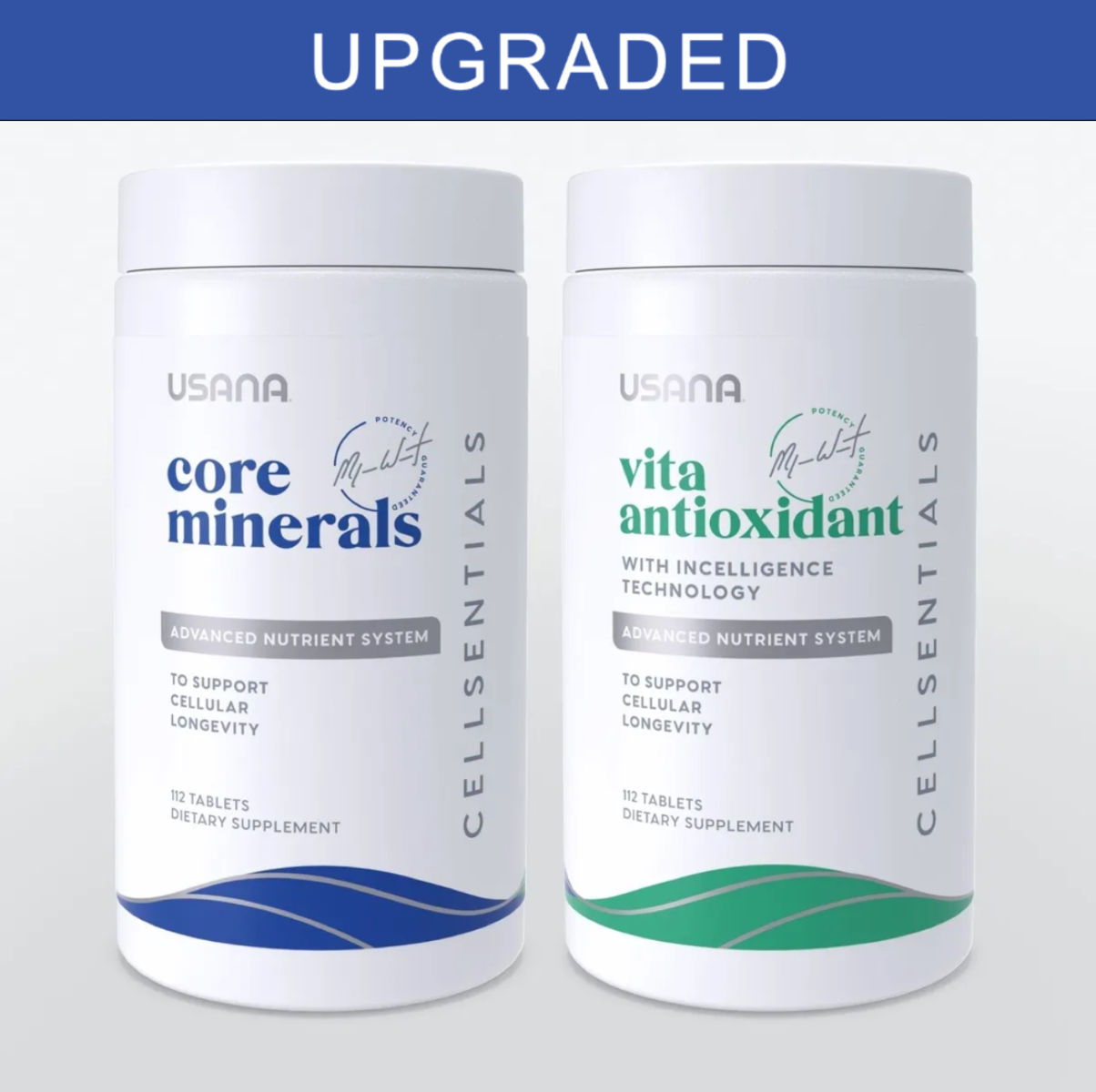
CellSentials is two products taken together, Vita Antioxidant and Core Minerals, and the label says to take two tablets of each twice a day, so a day is double the amounts per serving.[1] At that amount it provides 40 mg of niacin, 5 mg above the adult upper limit for niacin from supplements. No other nutrient on the label passes its upper limit on its own.[4] Both bottles are on NSF's certification listing for dietary supplements.[2]
What is in CellSentials? The ingredient label, as text
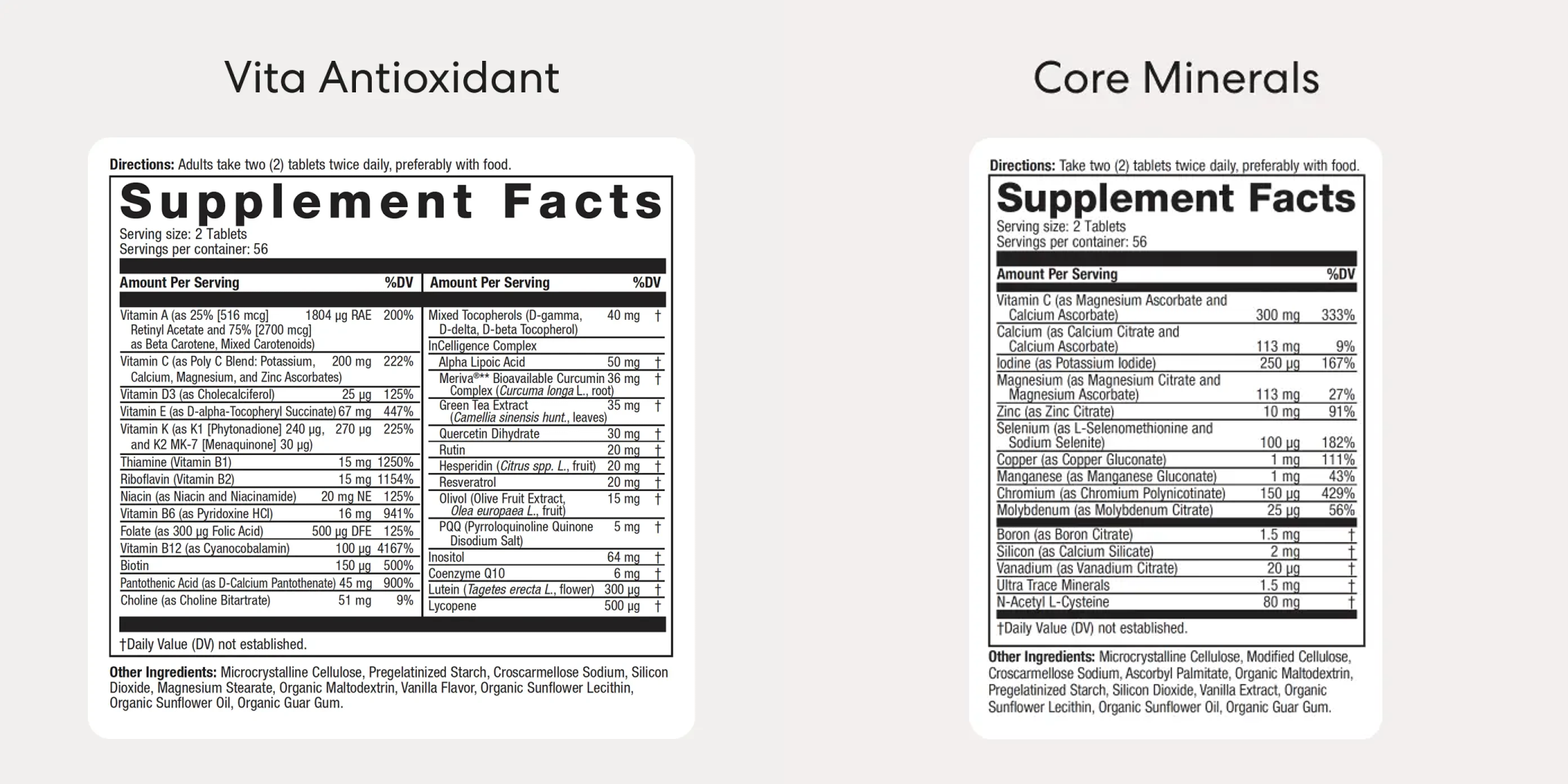
Joy Health transcribed every row below and checked it against the U.S. label USANA publishes.[1] Amounts, units, and % Daily Values are exactly as printed. Formulas change, so compare the label on your own package.
Directions on the label: Take two (2) tablets of each (Vita Antioxidant and Core Minerals) twice daily, preferably with food.
| Ingredient | Amount per serving | % Daily Value |
|---|---|---|
| Vitamin A (as 25% [516 mcg] Retinyl Acetate and 75% [2700 mcg] as Beta Carotene, Mixed Carotenoids) | 1804 µg RAE | 200% |
| Vitamin C (as Poly C Blend: Potassium, Calcium, Magnesium, and Zinc Ascorbates) | 200 mg | 222% |
| Vitamin D3 (as Cholecalciferol) | 25 µg | 125% |
| Vitamin E (as D-alpha-Tocopheryl Succinate) | 67 mg | 447% |
| Vitamin K (as K1 [Phytonadione] 240 µg, and K2 MK-7 [Menaquinone] 30 µg) | 270 µg | 225% |
| Thiamine (Vitamin B1) | 15 mg | 1250% |
| Riboflavin (Vitamin B2) | 15 mg | 1154% |
| Niacin (as Niacin and Niacinamide) | 20 mg NE | 125% |
| Vitamin B6 (as Pyridoxine HCl) | 16 mg | 941% |
| Folate (as 300 µg Folic Acid) | 500 µg DFE | 125% |
| Vitamin B12 (as Cyanocobalamin) | 100 µg | 4167% |
| Biotin | 150 µg | 500% |
| Pantothenic Acid (as D-Calcium Pantothenate) | 45 mg | 900% |
| Choline (as Choline Bitartrate) | 51 mg | 9% |
| Mixed Tocopherols (D-gamma, D-delta, D-beta Tocopherol) | 40 mg | † |
| InCelligence Complex | ||
| Alpha Lipoic Acid | 50 mg | † |
| Meriva® Bioavailable Curcumin Complex (Curcuma longa L., root) | 36 mg | † |
| Green Tea Extract (Camellia sinensis hunt., leaves) | 35 mg | † |
| Quercetin Dihydrate | 30 mg | † |
| Rutin | 20 mg | † |
| Hesperidin (Citrus spp. L., fruit) | 20 mg | † |
| Resveratrol | 20 mg | † |
| Olivol (Olive Fruit Extract, Olea europaea L., fruit) | 15 mg | † |
| PQQ (Pyrroloquinoline Quinone Disodium Salt) | 5 mg | † |
| Inositol | 64 mg | † |
| Coenzyme Q10 | 6 mg | † |
| Lutein (Tagetes erecta L., flower) | 300 µg | † |
| Lycopene | 500 µg | † |
†Daily Value (DV) not established.
| Ingredient | Amount per serving | % Daily Value |
|---|---|---|
| Vitamin C (as Magnesium Ascorbate and Calcium Ascorbate) | 300 mg | 333% |
| Calcium (as Calcium Citrate and Calcium Ascorbate) | 113 mg | 9% |
| Iodine (as Potassium Iodide) | 250 µg | 167% |
| Magnesium (as Magnesium Citrate and Magnesium Ascorbate) | 113 mg | 27% |
| Zinc (as Zinc Citrate) | 10 mg | 91% |
| Selenium (as L-Selenomethionine and Sodium Selenite) | 100 µg | 182% |
| Copper (as Copper Gluconate) | 1 mg | 111% |
| Manganese (as Manganese Gluconate) | 1 mg | 43% |
| Chromium (as Chromium Polynicotinate) | 150 µg | 429% |
| Molybdenum (as Molybdenum Citrate) | 25 µg | 56% |
| Boron (as Boron Citrate) | 1.5 mg | † |
| Silicon (as Calcium Silicate) | 2 mg | † |
| Vanadium (as Vanadium Citrate) | 20 µg | † |
| Ultra Trace Minerals | 1.5 mg | † |
| N-Acetyl L-Cysteine | 80 mg | † |
†Daily Value (DV) not established.
Other ingredients (Vita Antioxidant): Microcrystalline Cellulose, Pregelatinized Starch, Croscarmellose Sodium, Silicon Dioxide, Magnesium Stearate, Organic Maltodextrin, Vanilla Flavor, Organic Sunflower Lecithin, Organic Sunflower Oil, Organic Guar Gum.
Other ingredients (Core Minerals): Microcrystalline Cellulose, Modified Cellulose, Croscarmellose Sodium, Ascorbyl Palmitate, Organic Maltodextrin, Pregelatinized Starch, Silicon Dioxide, Vanilla Extract, Organic Sunflower Lecithin, Organic Sunflower Oil, Organic Guar Gum.
Two rows need a closer read. Vitamin A's 1,804 µg RAE is 25% preformed vitamin A (516 µg of retinyl acetate) and 75% beta carotene and mixed carotenoids, and only the preformed part counts toward vitamin A's upper limit.[1][6] Folate's 500 µg DFE comes from 300 µg of folic acid, which is what the folate upper limit counts.[13]
Earlier CellSentials label images carried a “Contains soy” badge. The current label USANA publishes carries no soy statement, and its lecithin is sunflower lecithin.[1] If soy matters to you, check the package you receive.
How much does CellSentials add up to in a day?
Two servings of each bottle a day put niacin at 40 mg. The upper limit, 35 mg, applies to both forms of niacin in supplements, niacin and niacinamide, and is based on skin flushing.[4] NIH describes that flushing as unpleasant rather than toxic and notes that niacinamide does not cause it. The label lists niacin “as niacin and niacinamide” without the split, so the label alone cannot tell you how likely flushing is.[1][4]
Vitamin B6 comes to 32 mg a day. That is under the U.S. upper limit of 100 mg but above the 12 mg adult limit that the European Food Safety Authority set in 2023, which NIH also reports.[5]
| Ingredient | CellSentials per day | Also in, per day | Adult UL |
|---|---|---|---|
| Vitamin A | 3,608 µg RAE (1,032 µg preformed) |
| 3,000 µg[6]Preformed vitamin A (retinol and retinyl esters) only; beta carotene is not counted |
| Vitamin C | 1,000 mg | 2,000 mg[16]Food and supplements | |
| Vitamin D | 50 µg |
| 100 µg[17]Daily intake; ODS notes that toxicity almost always comes from supplements |
| Vitamin E | 134 mg |
| 1,000 mg[9]Supplemental alpha-tocopherol only |
| Vitamin K | 540 µg |
| None set[7]No UL set |
| Thiamin | 30 mg |
| None set[18]No UL set |
| Riboflavin | 30 mg |
| None set[19]No UL set |
| Niacin | 40 mg NEAbove the 35 mg UL by 5 mg |
| 35 mg[4]Supplemental niacin only, both forms; based on skin flushing |
| Vitamin B6 | 32 mg |
| 100 mg[5]Food and supplements |
| Folate | 1,000 µg DFE (600 µg as folic acid) |
| 1,000 µg[13]Folic acid from supplements and fortified foods only |
| Vitamin B12 | 200 µg |
| None set[20]No UL set |
| Biotin | 300 µg |
| None set[8]No UL set |
| Pantothenic acid | 90 mg |
| None set[21]No UL set |
| Choline | 102 mg |
| 3,500 mg[22]Food and supplements |
| Mixed tocopherols | 80 mg |
| No UL |
| Alpha-lipoic acid | 100 mg |
| No UL |
| Curcumin complex (Meriva) | 72 mg | No UL | |
| Green tea extract | 70 mg |
| No UL |
| Quercetin | 60 mg |
| No UL |
| Rutin | 40 mg |
| No UL |
| Hesperidin | 40 mg |
| No UL |
| Resveratrol | 40 mg |
| No UL |
| Olive fruit extract (Olivol) | 30 mg |
| No UL |
| PQQ | 10 mg |
| No UL |
| Inositol | 128 mg |
| No UL |
| Coenzyme Q10 | 12 mg |
| No UL |
| Lutein | 600 µg |
| No UL |
| Lycopene | 1,000 µg |
| No UL |
| Calcium | 226 mg |
| 2,500 mg (2,000 mg from age 51)[23]Daily intake; food alone rarely reaches it |
| Iodine | 500 µg |
| 1,100 µg[24]Food and supplements |
| Magnesium | 226 mg |
| 350 mg[25]Supplements and medications only; magnesium in food is not counted |
| Zinc | 20 mg |
| 40 mg[26]Food and supplements |
| Selenium | 200 µg |
| 400 µg[27]Food and supplements |
| Copper | 2 mg |
| 10 mg[28]Food and supplements |
| Manganese | 2 mg | 11 mg[29]Food, water, and supplements | |
| Chromium | 300 µg |
| None set[30]No UL set |
| Molybdenum | 50 µg |
| 2,000 µg[31]All sources |
| Boron | 3 mg |
| 20 mg[32]Daily intake |
| Silicon | 4 mg |
| None set[33]No UL set (too little data) |
| Vanadium | 40 µg |
| 1.8 mg[33]Food, water, and supplements; adults only |
| Ultra trace minerals | 3 mg |
| No UL |
| N-acetyl L-cysteine | 160 mg |
| No UL |
Daily amounts multiply the label's per-serving amounts by the servings its directions call for. Food, drinks, fortified foods, and other supplements add to these totals. A Tolerable Upper Intake Level (UL) is the highest daily intake likely to pose no risk of adverse effects for almost all healthy people in an age group. It is not a recommended intake.[15]
Is CellSentials third-party tested?
Yes. Both halves are certified to NSF/ANSI 173: NSF's official listing for USANA's Salt Lake City facility names CellSentials Vita-Antioxidant and CellSentials Core Minerals under NSF/ANSI 173, each with a recommended daily serving of 4 tablets.[2] USANA also announced in March 2026 that CellSentials earned the ConsumerLab.com Seal of Approval after testing for potency, purity, and label accuracy. That is the company's description; ConsumerLab's own report was not available to us.[3]
Joy Health interpretation: both checks ask whether the tablets match their label and meet contaminant limits. Neither tells you whether a multivitamin is worth taking; the supplement evidence guide covers how to weigh that.
What to check before taking CellSentials
- Warfarin. CellSentials provides 540 µg of vitamin K a day. NIH notes that vitamin K can interact seriously with warfarin, and that people taking it need a consistent vitamin K intake.[7]
- Pregnancy. NIH advises people who are or might be pregnant not to take high doses of vitamin A supplements, above 3,000 µg RAE a day, and says to use the preformed share of a mixed label when comparing with that limit. CellSentials provides 3,608 µg RAE of vitamin A a day, of which 1,032 µg is preformed.[6]
- Blood tests. CellSentials has 300 µg of biotin a day. NIH warns that biotin above recommended intakes can cause falsely high or low results on some lab tests; the thyroid-test interference it describes followed a single 10 mg dose. Mention your supplements when you have blood drawn.[8]
- Cancer treatment. NIH notes that oncologists generally advise against antioxidant supplements during chemotherapy or radiotherapy.[9]
- Liver. Each serving includes 35 mg of green tea extract and 36 mg of Meriva, a bioavailable curcumin complex. NIH reports uncommon cases of liver injury with green tea extracts and with highly bioavailable curcumin products.[10][11]
- Doubling up. HealthPak repeats CellSentials' vitamins and minerals, so taking both doubles the amounts above. NIH notes that fortified foods and several supplements can add up to more than you think.[12]
FDA does not approve dietary supplements before they are sold, and it advises talking with a doctor, pharmacist, or other health professional before using one, because some supplements interact with medicines or other supplements.[14]
Affiliate disclosure: Joy Health may earn a commission if you buy through this link. It opens USANA's storefront, where you can check the current label and price for CellSentials.
See CellSentials on the USANA storeSources we read
Every source was read on September 23, 2026. Manufacturer documents are records of what the label says, not independent evidence that a product works.
- USANA, U.S. CellSentials Supplement Facts (Vita Antioxidant and Core Minerals)
USANA Health Sciences. The manufacturer's current U.S. label, used to check every transcribed row, the directions, and the allergen statement. A record of what the label says, not evidence that the product works. Read September 23, 2026.
- NSF Official Listings: USANA Health Sciences finished products under NSF/ANSI 173, Dietary Supplements
NSF. Independent certification record naming the Salt Lake City facility, 11 USANA finished products, and the manufacturer's recommended daily serving for each. A listing covers the named products, not the whole catalog. Read September 23, 2026.
- Tested, Trusted, Approved: USANA CellSentials Earns ConsumerLab.com Seal of Approval for Purity and Potency
USANA Health Sciences, March 24, 2026. Company announcement of the ConsumerLab.com seal and the reported testing scope. ConsumerLab's own report was not available to us. Read September 23, 2026.
- Niacin: Fact Sheet for Health Professionals
NIH Office of Dietary Supplements. Used for the niacin upper limit, its basis in skin flushing, and how niacinamide differs. Read September 23, 2026.
- Vitamin B6: Fact Sheet for Health Professionals
NIH Office of Dietary Supplements. Used for the U.S. upper limit and the lower 2023 European limit. Read September 23, 2026.
- Vitamin A and Carotenoids: Fact Sheet for Health Professionals
NIH Office of Dietary Supplements. Used for which vitamin A counts toward the upper limit and the pregnancy caution. Read September 23, 2026.
- Vitamin K: Fact Sheet for Health Professionals
NIH Office of Dietary Supplements. Used for the warfarin interaction. Read September 23, 2026.
- Biotin: Fact Sheet for Health Professionals
NIH Office of Dietary Supplements. Used for lab-test interference. Read September 23, 2026.
- Vitamin E: Fact Sheet for Health Professionals
NIH Office of Dietary Supplements. Used for the caution about antioxidant supplements during cancer treatment. Read September 23, 2026.
- Green Tea
NIH National Center for Complementary and Integrative Health. Used for liver injury reports with green tea extracts. Read September 23, 2026.
- Turmeric
NIH National Center for Complementary and Integrative Health. Used for liver injury reports with highly bioavailable curcumin formulations. Read September 23, 2026.
- Dietary Supplements: What You Need to Know
NIH Office of Dietary Supplements. Used for how fortified foods and multiple supplements add up. Read September 23, 2026.
- Folate: Fact Sheet for Health Professionals
NIH Office of Dietary Supplements. Used for the folic acid upper limit. Read September 23, 2026.
- Questions and Answers on Dietary Supplements
U.S. Food and Drug Administration. Used for premarket approval and the advice to talk with a health professional because supplements can interact with medicines. Read September 23, 2026.
- Dietary Reference Intakes for Vitamin A, Vitamin K, Arsenic, Boron, Chromium, Copper, Iodine, Iron, Manganese, Molybdenum, Nickel, Silicon, Vanadium, and Zinc, Chapter 1
Institute of Medicine (National Academies Press), 2001. Used for what a Tolerable Upper Intake Level means and that it is not a recommended intake. Read September 23, 2026.
- Vitamin C: Fact Sheet for Health Professionals
NIH Office of Dietary Supplements. Used for the adult Tolerable Upper Intake Level and what it counts. Read September 23, 2026.
- Vitamin D: Fact Sheet for Health Professionals
NIH Office of Dietary Supplements. Used for the adult Tolerable Upper Intake Level and what it counts. Read September 23, 2026.
- Thiamin: Fact Sheet for Health Professionals
NIH Office of Dietary Supplements. Used for the adult Tolerable Upper Intake Level and what it counts. Read September 23, 2026.
- Riboflavin: Fact Sheet for Health Professionals
NIH Office of Dietary Supplements. Used for the adult Tolerable Upper Intake Level and what it counts. Read September 23, 2026.
- Vitamin B12: Fact Sheet for Health Professionals
NIH Office of Dietary Supplements. Used for the adult Tolerable Upper Intake Level and what it counts. Read September 23, 2026.
- Pantothenic Acid: Fact Sheet for Health Professionals
NIH Office of Dietary Supplements. Used for the adult Tolerable Upper Intake Level and what it counts. Read September 23, 2026.
- Choline: Fact Sheet for Health Professionals
NIH Office of Dietary Supplements. Used for the adult Tolerable Upper Intake Level and what it counts. Read September 23, 2026.
- Calcium: Fact Sheet for Health Professionals
NIH Office of Dietary Supplements. Used for the adult Tolerable Upper Intake Level and what it counts. Read September 23, 2026.
- Iodine: Fact Sheet for Health Professionals
NIH Office of Dietary Supplements. Used for the adult Tolerable Upper Intake Level and what it counts. Read September 23, 2026.
- Magnesium: Fact Sheet for Health Professionals
NIH Office of Dietary Supplements. Used for the adult Tolerable Upper Intake Level and what it counts. Read September 23, 2026.
- Zinc: Fact Sheet for Health Professionals
NIH Office of Dietary Supplements. Used for the adult Tolerable Upper Intake Level and what it counts. Read September 23, 2026.
- Selenium: Fact Sheet for Health Professionals
NIH Office of Dietary Supplements. Used for the adult Tolerable Upper Intake Level and what it counts. Read September 23, 2026.
- Copper: Fact Sheet for Health Professionals
NIH Office of Dietary Supplements. Used for the adult Tolerable Upper Intake Level and what it counts. Read September 23, 2026.
- Manganese: Fact Sheet for Health Professionals
NIH Office of Dietary Supplements. Used for the adult Tolerable Upper Intake Level and what it counts. Read September 23, 2026.
- Chromium: Fact Sheet for Health Professionals
NIH Office of Dietary Supplements. Used for the adult Tolerable Upper Intake Level and what it counts. Read September 23, 2026.
- Molybdenum: Fact Sheet for Health Professionals
NIH Office of Dietary Supplements. Used for the adult Tolerable Upper Intake Level and what it counts. Read September 23, 2026.
- Boron: Fact Sheet for Health Professionals
NIH Office of Dietary Supplements. Used for the adult Tolerable Upper Intake Level and what it counts. Read September 23, 2026.
- Dietary Reference Intakes for Vitamin A, Vitamin K, Arsenic, Boron, Chromium, Copper, Iodine, Iron, Manganese, Molybdenum, Nickel, Silicon, Vanadium, and Zinc, Chapter 13
Institute of Medicine (National Academies Press), 2001. Used for the adult Tolerable Upper Intake Level and what it counts. Read September 23, 2026.
About this page
Prepared by Joy Health
Joy Health is an educational publisher, not a medical practice. The label transcription and daily totals are Joy Health's work; the upper limits come from the National Academies as reported by NIH. No external clinical reviewer participated. Joy Health earns commissions on purchases made through the storefront link on this page.
Read our editorial standards