USANA supplement label
MagneCal D: calcium, magnesium, and vitamin D per day
The MagneCal D label says to take two tablets twice a day, which provides 520 mg of calcium, 520 mg of magnesium, 25 µg of vitamin D3, and 1.32 mg of boron a day.[1] That magnesium total is 170 mg above 350 mg, the adult upper limit for magnesium from supplements.[5]
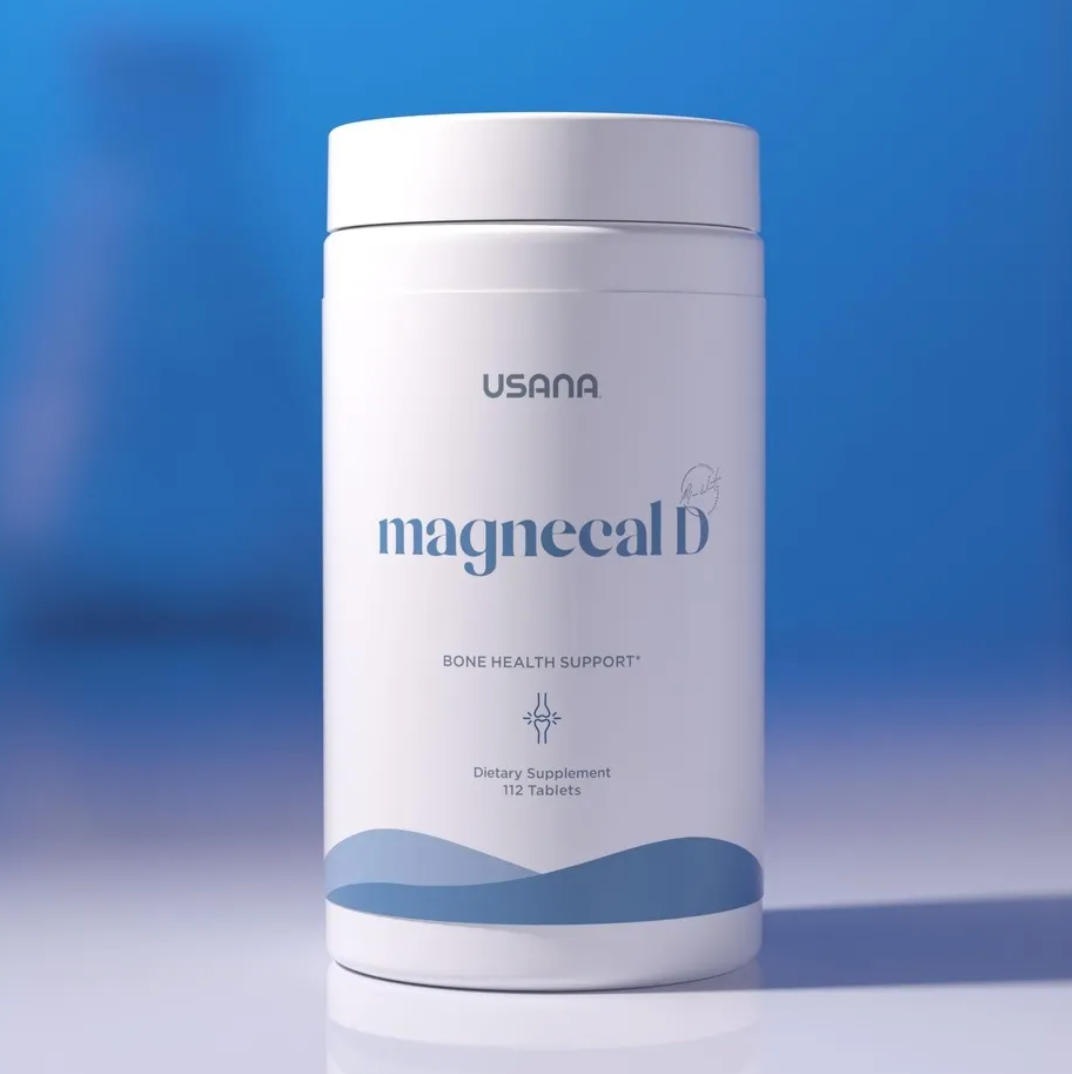
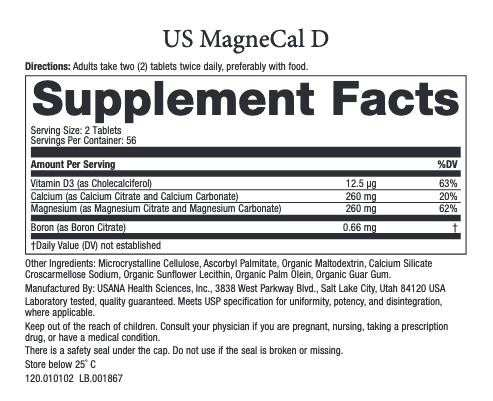
What is in MagneCal D? The ingredient label, as text
Joy Health transcribed every row below and checked it against the U.S. label USANA publishes.[1] Amounts, units, and % Daily Values are exactly as printed. Formulas change, so compare the label on your own package.
Directions on the label: Adults take two (2) tablets twice daily, preferably with food.
| Ingredient | Amount per serving | % Daily Value |
|---|---|---|
| Vitamin D3 (as Cholecalciferol) | 12.5 µg | 63% |
| Calcium (as Calcium Citrate and Calcium Carbonate) | 260 mg | 20% |
| Magnesium (as Magnesium Citrate and Magnesium Carbonate) | 260 mg | 62% |
| Boron (as Boron Citrate) | 0.66 mg | † |
†Daily Value (DV) not established
Other ingredients: Microcrystalline Cellulose, Ascorbyl Palmitate, Organic Maltodextrin, Calcium Silicate, Croscarmellose Sodium, Organic Sunflower Lecithin, Organic Palm Olein, Organic Guar Gum.
The directions differ by source. The printed label says two tablets twice daily, and NSF's listing gives a recommended daily serving of 4 tablets.[1][2] USANA's product page says two tablets a day, which would halve every daily amount below and put magnesium at 260 mg.[3] We use the printed label.
The calcium and magnesium come from citrate and carbonate forms.[1] NIH lists magnesium carbonate among the forms most often reported to cause diarrhea.[5]
How much does MagneCal D add up to in a day?
At four tablets a day, magnesium is 520 mg. The adult upper limit of 350 mg counts only magnesium from supplements and medications, which is why it sits below the recommended total intake for many adults; food does not change the comparison. NIH notes that high doses of supplemental magnesium often cause diarrhea, sometimes with nausea and abdominal cramping, and that the risk of toxicity rises with impaired kidney function.[5] Calcium, at 520 mg, and vitamin D, at 25 µg, are under their upper limits on their own, though both add to what food and other supplements provide.
| Ingredient | MagneCal D per day | Also in, per day | Adult UL |
|---|---|---|---|
| Vitamin D | 25 µg |
| 100 µg[7]Daily intake; ODS notes that toxicity almost always comes from supplements |
| Calcium | 520 mg |
| 2,500 mg (2,000 mg from age 51)[6]Daily intake; food alone rarely reaches it |
| Magnesium | 520 mgAbove the 350 mg UL by 170 mg |
| 350 mg[5]Supplements and medications only; magnesium in food is not counted |
| Boron | 1.32 mg |
| 20 mg[10]Daily intake |
Daily amounts multiply the label's per-serving amounts by the servings its directions call for. Food, drinks, fortified foods, and other supplements add to these totals. A Tolerable Upper Intake Level (UL) is the highest daily intake likely to pose no risk of adverse effects for almost all healthy people in an age group. It is not a recommended intake.[9]
Is MagneCal D third-party tested?
Yes. MagneCal D is certified to NSF/ANSI 173: NSF's official listing for USANA's Salt Lake City facility names MagneCal™ D under NSF/ANSI 173, with a recommended daily serving of 4 tablets.[2] USANA also announced in November 2025 that MagneCal D earned the ConsumerLab.com Seal of Approval after testing showed it delivered its claimed calcium, magnesium, vitamin D, and boron and disintegrated properly. That is the company's account; ConsumerLab's report was not available to us.[4]
Joy Health interpretation: both checks ask whether the tablets match their label. They do not change the magnesium arithmetic above.
What to check before taking MagneCal D
- Kidney disease. The risk of magnesium toxicity rises with impaired kidney function.[5]
- Medicines that bind minerals. NIH notes that spacing magnesium-containing supplements at least 2 hours from oral bisphosphonates can minimize an interaction, and that tetracycline and quinolone antibiotics should be taken at least 2 hours before or 4 to 6 hours after them.[5] Levothyroxine's label says to avoid taking it within 4 hours of calcium carbonate supplements.[6]
- Water pills. NIH notes that thiazide diuretics combined with vitamin D supplements might lead to high blood calcium, especially in older adults and people with reduced kidney function.[7]
- Calcium supplements. NIH notes that higher intakes of supplemental calcium might increase the risk of kidney stones, and that some research suggests calcium supplements could raise cardiovascular risk.[6]
- Doubling up. Taking MagneCal D with CellSentials at both labels' directions adds up to 746 mg of supplemental magnesium a day. By our reading of the labels, each HealthPak packet already holds the equivalent of one MagneCal D tablet, so taking both adds to the magnesium total too.
FDA does not approve dietary supplements before they are sold, and it advises talking with a doctor, pharmacist, or other health professional before using one, because some supplements interact with medicines or other supplements.[8]
Affiliate disclosure: Joy Health may earn a commission if you buy through this link. It opens USANA's storefront, where you can check the current label and price for MagneCal D.
See MagneCal D on the USANA storeSources we read
Every source was read on September 23, 2026. Manufacturer documents are records of what the label says, not independent evidence that a product works.
- USANA, U.S. MagneCal D Supplement Facts
USANA Health Sciences. The manufacturer's current U.S. label, used to check every transcribed row, the directions, and the allergen statement. A record of what the label says, not evidence that the product works. Read September 23, 2026.
- NSF Official Listings: USANA Health Sciences finished products under NSF/ANSI 173, Dietary Supplements
NSF. Independent certification record naming the Salt Lake City facility, 11 USANA finished products, and the manufacturer's recommended daily serving for each. A listing covers the named products, not the whole catalog. Read September 23, 2026.
- MagneCal D product data (the How to Use text on USANA's product page)
USANA Health Sciences. The data behind USANA's MagneCal D product page, used only for its directions, which differ from the printed label. Read September 23, 2026.
- Proven Power for Strong Bone Support: USANA's MagneCal D Earns ConsumerLab.com Seal of Approval
USANA Health Sciences, November 11, 2025. Company announcement of the ConsumerLab.com seal and the reported checks for claimed amounts and disintegration. ConsumerLab's own report was not available to us. Read September 23, 2026.
- Magnesium: Fact Sheet for Health Professionals
NIH Office of Dietary Supplements. Used for the supplemental magnesium upper limit, effects of high doses, forms that often cause diarrhea, kidney function, and spacing from medicines. Read September 23, 2026.
- Calcium: Fact Sheet for Health Professionals
NIH Office of Dietary Supplements. Used for kidney stones, cardiovascular questions, and spacing calcium carbonate from levothyroxine. Read September 23, 2026.
- Vitamin D: Fact Sheet for Health Professionals
NIH Office of Dietary Supplements. Used for combining vitamin D with calcium supplements and with thiazide diuretics. Read September 23, 2026.
- Questions and Answers on Dietary Supplements
U.S. Food and Drug Administration. Used for premarket approval and the advice to talk with a health professional because supplements can interact with medicines. Read September 23, 2026.
- Dietary Reference Intakes for Vitamin A, Vitamin K, Arsenic, Boron, Chromium, Copper, Iodine, Iron, Manganese, Molybdenum, Nickel, Silicon, Vanadium, and Zinc, Chapter 1
Institute of Medicine (National Academies Press), 2001. Used for what a Tolerable Upper Intake Level means and that it is not a recommended intake. Read September 23, 2026.
- Boron: Fact Sheet for Health Professionals
NIH Office of Dietary Supplements. Used for the adult Tolerable Upper Intake Level and what it counts. Read September 23, 2026.
About this page
Prepared by Joy Health
Joy Health is an educational publisher, not a medical practice. The label transcription and daily totals are Joy Health's work; the upper limits come from the National Academies as reported by NIH. No external clinical reviewer participated. Joy Health earns commissions on purchases made through the storefront link on this page.
Read our editorial standards