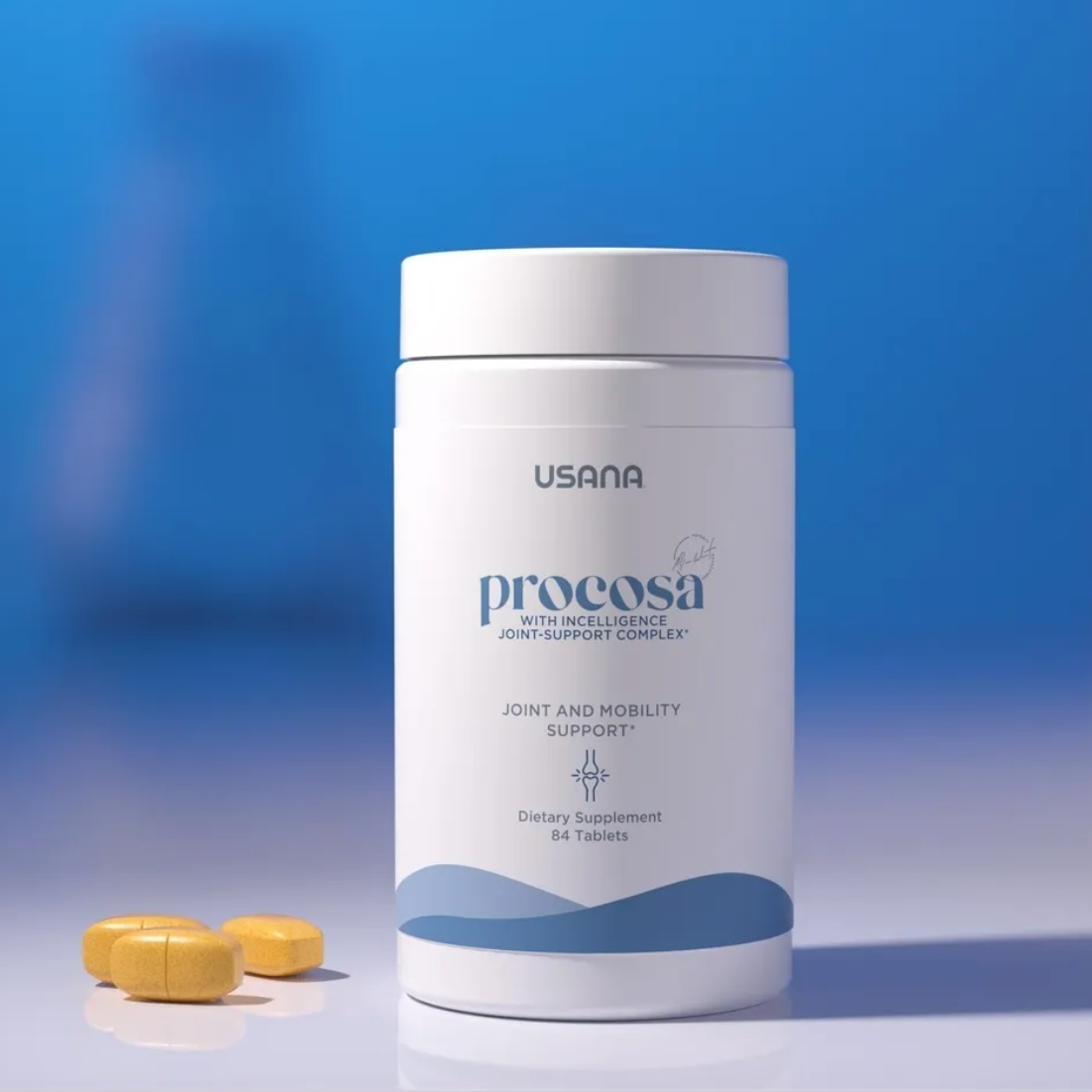
USANA supplement label
Procosa: glucosamine, curcumin, and the full label
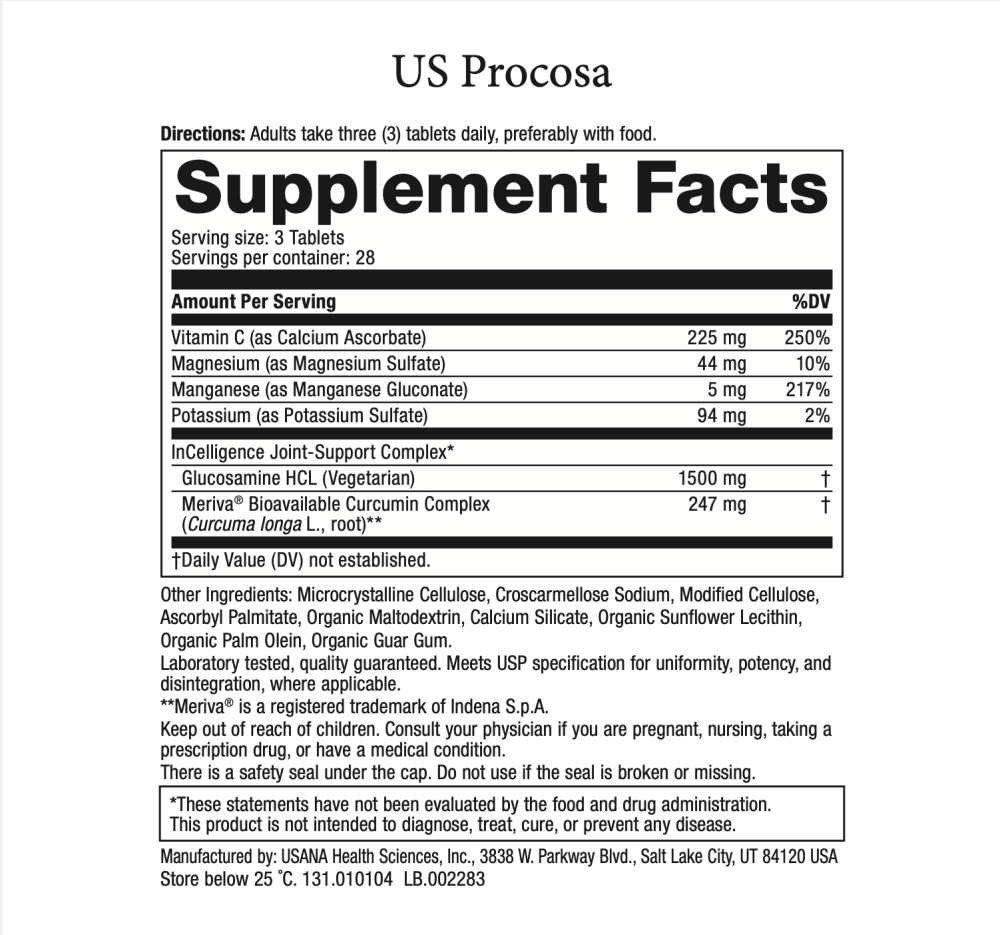
Three Procosa tablets, the daily amount on the label, provide 1,500 mg of vegetarian glucosamine hydrochloride and 247 mg of Meriva curcumin complex, plus 225 mg of vitamin C, 44 mg of magnesium, 5 mg of manganese, and 94 mg of potassium.[1] Procosa is on NSF's certification listing for dietary supplements.[2]
What is in Procosa? The ingredient label, as text
Joy Health transcribed every row below and checked it against the U.S. label USANA publishes.[1] Amounts, units, and % Daily Values are exactly as printed. Formulas change, so compare the label on your own package.
Directions on the label: Adults take three (3) tablets daily, preferably with food.
| Ingredient | Amount per serving | % Daily Value |
|---|---|---|
| Vitamin C (as Calcium Ascorbate) | 225 mg | 250% |
| Magnesium (as Magnesium Sulfate) | 44 mg | 10% |
| Manganese (as Manganese Gluconate) | 5 mg | 217% |
| Potassium (as Potassium Sulfate) | 94 mg | 2% |
| InCelligence Joint-Support Complex | ||
| Glucosamine HCL (Vegetarian) | 1500 mg | † |
| Meriva® Bioavailable Curcumin Complex (Curcuma longa L., root) | 247 mg | † |
†Daily Value (DV) not established.
Other ingredients: Microcrystalline Cellulose, Croscarmellose Sodium, Modified Cellulose, Ascorbyl Palmitate, Organic Maltodextrin, Calcium Silicate, Organic Sunflower Lecithin, Organic Palm Olein, Organic Guar Gum.
Glucosamine and the curcumin complex sit inside what the label calls the InCelligence Joint-Support Complex, and neither has a Daily Value. The label names the curcumin ingredient “Meriva Bioavailable Curcumin Complex.”[1]
How much does Procosa add up to in a day?
Manganese is the Procosa nutrient closest to an upper limit, at 5 mg a day against 11 mg. CellSentials and HealthPak each add 2 mg a day, which brings a combination to 7 mg before food. NIH notes that people with chronic liver disease are more susceptible to excess manganese.[5]
| Ingredient | Procosa per day | Also in, per day | Adult UL |
|---|---|---|---|
| Vitamin C | 225 mg |
| 2,000 mg[8]Food and supplements |
| Magnesium | 44 mg |
| 350 mg[9]Supplements and medications only; magnesium in food is not counted |
| Manganese | 5 mg |
| 11 mg[5]Food, water, and supplements |
| Potassium | 94 mg |
| No UL |
| Curcumin complex (Meriva) | 247 mg |
| No UL |
Daily amounts multiply the label's per-serving amounts by the servings its directions call for. Food, drinks, fortified foods, and other supplements add to these totals. A Tolerable Upper Intake Level (UL) is the highest daily intake likely to pose no risk of adverse effects for almost all healthy people in an age group. It is not a recommended intake.[7]
Is Procosa third-party tested?
Yes. Procosa is certified to NSF/ANSI 173: NSF's official listing for USANA's Salt Lake City facility names PROCOSA™ under NSF/ANSI 173, with a recommended daily serving of 3 tablets.[2]
Joy Health interpretation: the listing is about whether the tablets match their label. Whether glucosamine or curcumin helps joints is a separate evidence question; the supplement evidence guide explains how to check a claim like that.
What to check before taking Procosa
- Warfarin. NIH notes that glucosamine and chondroitin have been associated with an increased risk of bleeding in people taking warfarin.[3]
- Blood sugar. Glucosamine may raise blood glucose in some people, NIH reports.[3]
- Liver. NIH reports liver damage in some people who took highly bioavailable curcumin formulations, and people with chronic liver disease are more susceptible to excess manganese.[4][5]
- Pregnancy and breastfeeding. NIH says turmeric supplements during pregnancy may be unsafe, and that little is known about glucosamine during pregnancy or breastfeeding.[3][4]
FDA does not approve dietary supplements before they are sold, and it advises talking with a doctor, pharmacist, or other health professional before using one, because some supplements interact with medicines or other supplements.[6]
Affiliate disclosure: Joy Health may earn a commission if you buy through this link. It opens USANA's storefront, where you can check the current label and price for Procosa.
See Procosa on the USANA storeSources we read
Every source was read on September 23, 2026. Manufacturer documents are records of what the label says, not independent evidence that a product works.
- USANA, U.S. Procosa Supplement Facts
USANA Health Sciences. The manufacturer's current U.S. label, used to check every transcribed row, the directions, and the allergen statement. A record of what the label says, not evidence that the product works. Read September 23, 2026.
- NSF Official Listings: USANA Health Sciences finished products under NSF/ANSI 173, Dietary Supplements
NSF. Independent certification record naming the Salt Lake City facility, 11 USANA finished products, and the manufacturer's recommended daily serving for each. A listing covers the named products, not the whole catalog. Read September 23, 2026.
- Glucosamine and Chondroitin for Osteoarthritis: What You Need To Know
NIH National Center for Complementary and Integrative Health. Used for blood glucose, warfarin, and pregnancy notes. Limitation: it covers glucosamine generally and does not distinguish vegetarian sources. Read September 23, 2026.
- Turmeric
NIH National Center for Complementary and Integrative Health. Used for liver injury reports with highly bioavailable curcumin formulations and the pregnancy caution. Read September 23, 2026.
- Manganese: Fact Sheet for Health Professionals
NIH Office of Dietary Supplements. Used for the manganese upper limit and liver disease. Read September 23, 2026.
- Questions and Answers on Dietary Supplements
U.S. Food and Drug Administration. Used for premarket approval and the advice to talk with a health professional because supplements can interact with medicines. Read September 23, 2026.
- Dietary Reference Intakes for Vitamin A, Vitamin K, Arsenic, Boron, Chromium, Copper, Iodine, Iron, Manganese, Molybdenum, Nickel, Silicon, Vanadium, and Zinc, Chapter 1
Institute of Medicine (National Academies Press), 2001. Used for what a Tolerable Upper Intake Level means and that it is not a recommended intake. Read September 23, 2026.
- Vitamin C: Fact Sheet for Health Professionals
NIH Office of Dietary Supplements. Used for the adult Tolerable Upper Intake Level and what it counts. Read September 23, 2026.
- Magnesium: Fact Sheet for Health Professionals
NIH Office of Dietary Supplements. Used for the adult Tolerable Upper Intake Level and what it counts. Read September 23, 2026.
About this page
Prepared by Joy Health
Joy Health is an educational publisher, not a medical practice. The label transcription and daily totals are Joy Health's work; the upper limits come from the National Academies as reported by NIH. No external clinical reviewer participated. Joy Health earns commissions on purchases made through the storefront link on this page.
Read our editorial standards