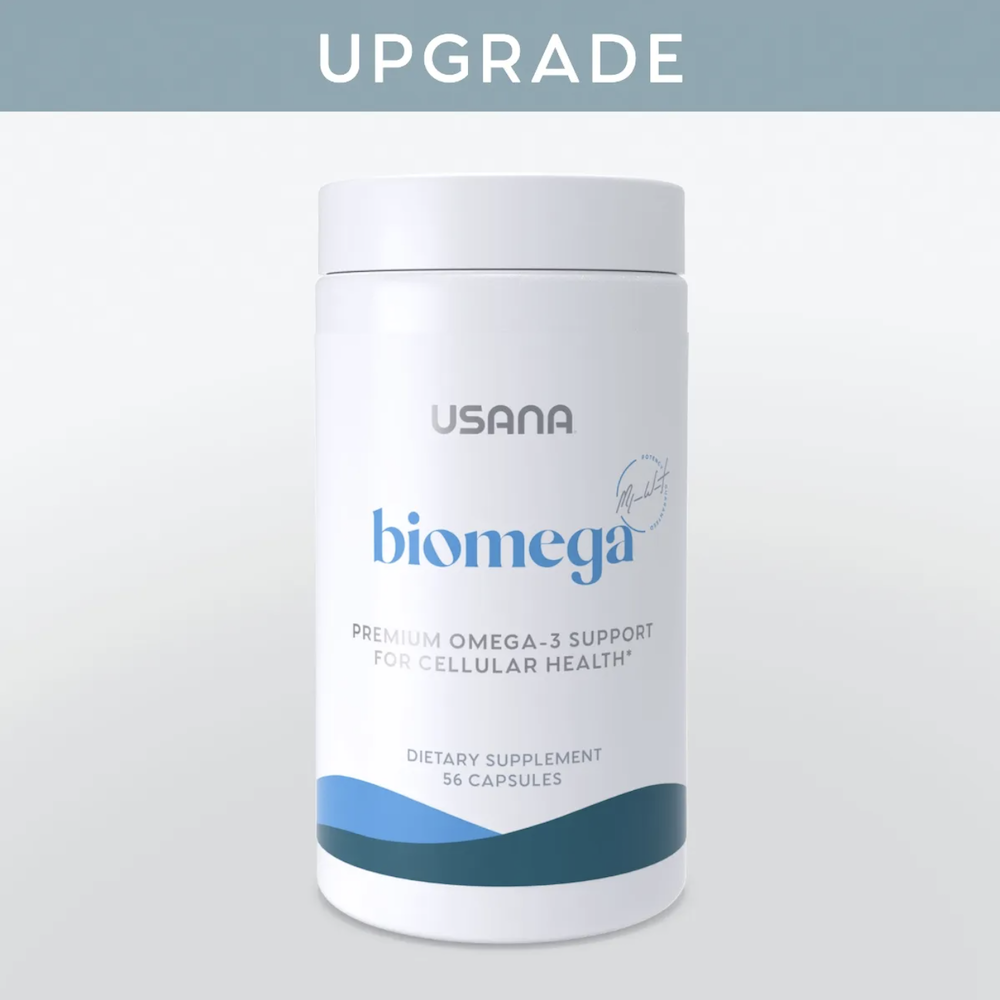
USANA supplement label
BiOmega: EPA, DHA, and vitamin D per serving
Two BiOmega capsules, the daily amount on the label, provide 1,200 mg of omega-3 fatty acids, including 640 mg of EPA and 460 mg of DHA, plus 5 µg of vitamin D3.[1] BiOmega is also one of the USANA products on NSF's certification listing for dietary supplements.[2]
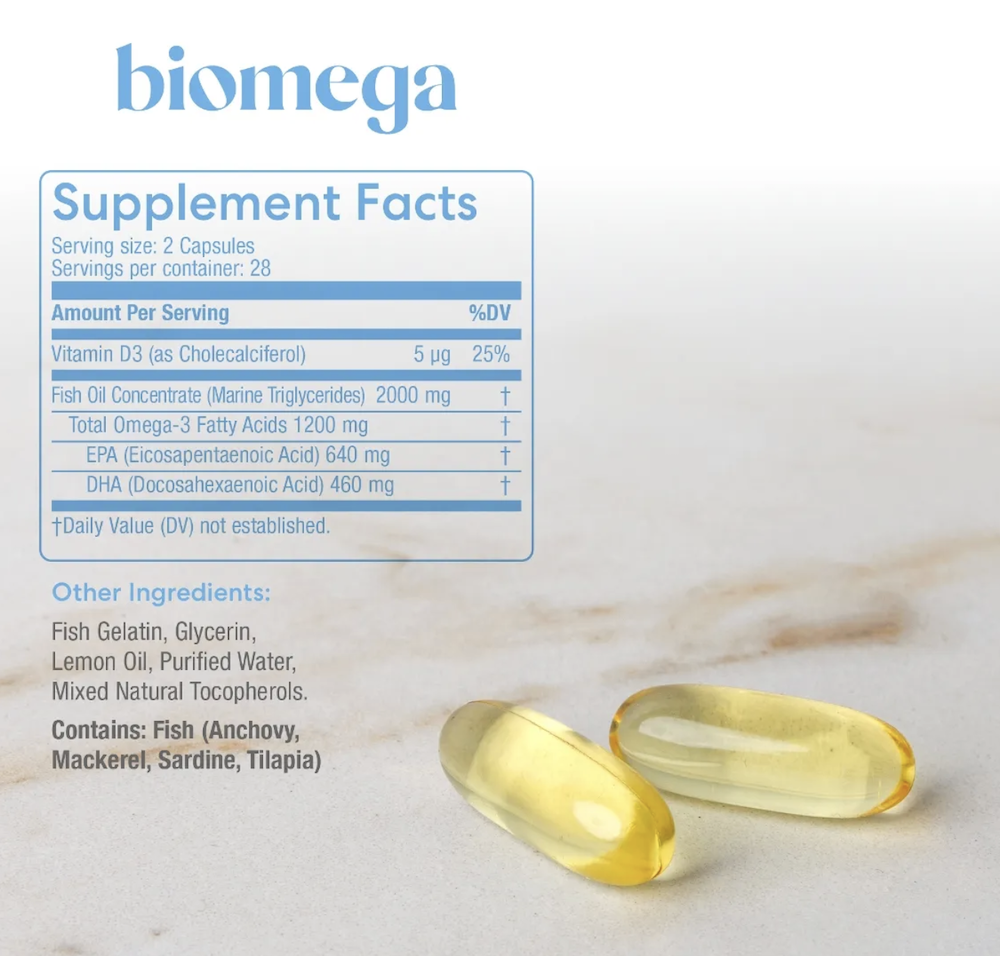
What is in BiOmega? The ingredient label, as text
Joy Health transcribed every row below and checked it against the U.S. label USANA publishes.[1] Amounts, units, and % Daily Values are exactly as printed. Formulas change, so compare the label on your own package.
Directions on the label: Take two (2) capsules daily, preferably with food.
| Ingredient | Amount per serving | % Daily Value |
|---|---|---|
| Vitamin D3 (as Cholecalciferol) | 5 µg | 25% |
| Fish Oil Concentrate (Marine Triglycerides) | 2000 mg | † |
| Total Omega-3 Fatty Acids | 1200 mg | † |
| EPA (Eicosapentaenoic Acid) | 640 mg | † |
| DHA (Docosahexaenoic Acid) | 460 mg | † |
†Daily Value (DV) not established.
Other ingredients: Fish Gelatin, Glycerin, Lemon Oil, Purified Water, Mixed Natural Tocopherols.
Contains: Fish (anchovy, mackerel, sardine, tilapia)
EPA and DHA are listed inside the total omega-3 amount. Together they make up 1,100 mg of the 1,200 mg; the label does not name the other 100 mg. The fish behind the oil are named in the allergen line: anchovy, mackerel, sardine, and tilapia.[1]
How much does BiOmega add up to in a day?
At two capsules a day, vitamin D is the only BiOmega ingredient with an adult Tolerable Upper Intake Level (UL), and 5 µg is small next to the 100 µg limit. It does add to the vitamin D in the other products below, and NIH notes that vitamin D toxicity almost always comes from supplements.[5] Fish oil has no UL. FDA has concluded that supplements providing no more than 5 g of EPA and DHA a day, used as labeled, are safe and lawful; two capsules provide 1.1 g.[4]
| Ingredient | BiOmega per day | Also in, per day | Adult UL |
|---|---|---|---|
| Vitamin D | 5 µg |
| 100 µg[5]Daily intake; ODS notes that toxicity almost always comes from supplements |
Daily amounts multiply the label's per-serving amounts by the servings its directions call for. Food, drinks, fortified foods, and other supplements add to these totals. A Tolerable Upper Intake Level (UL) is the highest daily intake likely to pose no risk of adverse effects for almost all healthy people in an age group. It is not a recommended intake.[9]
Is BiOmega third-party tested?
Yes. BiOmega is certified to NSF/ANSI 173: NSF's official listing for USANA's Salt Lake City facility names “OPTIMIZERS™, BiOmega™” under NSF/ANSI 173, the dietary supplement standard, with a recommended daily serving of 2 gelcaps.[2] NIH describes this kind of third-party certification as independent assurance that a product contains the labeled amounts of its ingredients.[6]
Joy Health interpretation: the listing answers a quality question about this product. It does not show that fish oil will do a particular thing for a particular person; the supplement evidence guide explains how to match a claim to evidence.
What to check before taking BiOmega
- Fish allergy. The label says it contains fish: anchovy, mackerel, sardine, and tilapia.[1]
- Blood thinners. NIH notes that fish oil might prolong clotting times when taken with warfarin, though most research finds that 3 to 6 g of fish oil a day does not significantly change anticoagulant status.[3]
- Heart rhythm. Two large trials found that 4 g a day of prescription omega-3 products slightly raised the risk of atrial fibrillation in people with or at high risk of heart disease.[3] Those trials used different products at several times this dose, so ask a clinician if you have a heart rhythm condition rather than assuming either way.
- Surgery. FDA notes that a clinician may ask you to stop supplements two or three weeks before a procedure, in part because of bleeding risk.[7]
- Vitamin D from several products. Add BiOmega's 5 µg to any other vitamin D you take; the table above shows the amounts in the other products on this site.
FDA does not approve dietary supplements before they are sold, and it advises talking with a doctor, pharmacist, or other health professional before using one, because some supplements interact with medicines or other supplements.[8]
Affiliate disclosure: Joy Health may earn a commission if you buy through this link. It opens USANA's storefront, where you can check the current label and price for BiOmega.
See BiOmega on the USANA storeSources we read
Every source was read on September 23, 2026. Manufacturer documents are records of what the label says, not independent evidence that a product works.
- USANA, U.S. BiOmega Supplement Facts
USANA Health Sciences. The manufacturer's current U.S. label, used to check every transcribed row, the directions, and the allergen statement. A record of what the label says, not evidence that the product works. Read September 23, 2026.
- NSF Official Listings: USANA Health Sciences finished products under NSF/ANSI 173, Dietary Supplements
NSF. Independent certification record naming the Salt Lake City facility, 11 USANA finished products, and the manufacturer's recommended daily serving for each. A listing covers the named products, not the whole catalog. Read September 23, 2026.
- Omega-3 Fatty Acids: Fact Sheet for Health Professionals
NIH Office of Dietary Supplements. Used for the warfarin and atrial fibrillation findings. Limitation: the atrial fibrillation trials used 4 g a day of prescription products in people with or at high risk of cardiovascular disease. Read September 23, 2026.
- Response to the Petition for a Health Claim for Eicosapentaenoic Acid and Docosahexaenoic Acid and Reduction of Blood Pressure in the General Population (Docket No. FDA-2014-Q-1146)
U.S. Food and Drug Administration, letter to the Global Organization for EPA and DHA Omega-3s, 2019. Used for FDA's conclusion that supplements providing no more than 5 g a day of EPA and DHA are safe and lawful when used as labeled. Read September 23, 2026.
- Vitamin D: Fact Sheet for Health Professionals
NIH Office of Dietary Supplements. Used for where vitamin D toxicity comes from. Read September 23, 2026.
- Dietary Supplements for Exercise and Athletic Performance: Fact Sheet for Health Professionals
NIH Office of Dietary Supplements. Used for what third-party certification checks, and for creatine, protein, and HMB safety notes. Read September 23, 2026.
- Mixing Medications and Dietary Supplements Can Endanger Your Health
U.S. Food and Drug Administration. Consumer update used for interactions and stopping supplements before surgery. Read September 23, 2026.
- Questions and Answers on Dietary Supplements
U.S. Food and Drug Administration. Used for premarket approval and the advice to talk with a health professional because supplements can interact with medicines. Read September 23, 2026.
- Dietary Reference Intakes for Vitamin A, Vitamin K, Arsenic, Boron, Chromium, Copper, Iodine, Iron, Manganese, Molybdenum, Nickel, Silicon, Vanadium, and Zinc, Chapter 1
Institute of Medicine (National Academies Press), 2001. Used for what a Tolerable Upper Intake Level means and that it is not a recommended intake. Read September 23, 2026.
About this page
Prepared by Joy Health
Joy Health is an educational publisher, not a medical practice. The label transcription and daily totals are Joy Health's work; the upper limits come from the National Academies as reported by NIH. No external clinical reviewer participated. Joy Health earns commissions on purchases made through the storefront link on this page.
Read our editorial standards