USANA supplement label
Core Aminos: essential amino acids and HMB per scoop
One scoop of Core Aminos lists nine essential amino acids totaling 5,050 mg, led by 2,000 mg of leucine, plus 1,500 mg of calcium beta-hydroxy beta-methylbutyrate, known as calcium HMB. The label says how to mix a scoop but not how many to take in a day.[1]
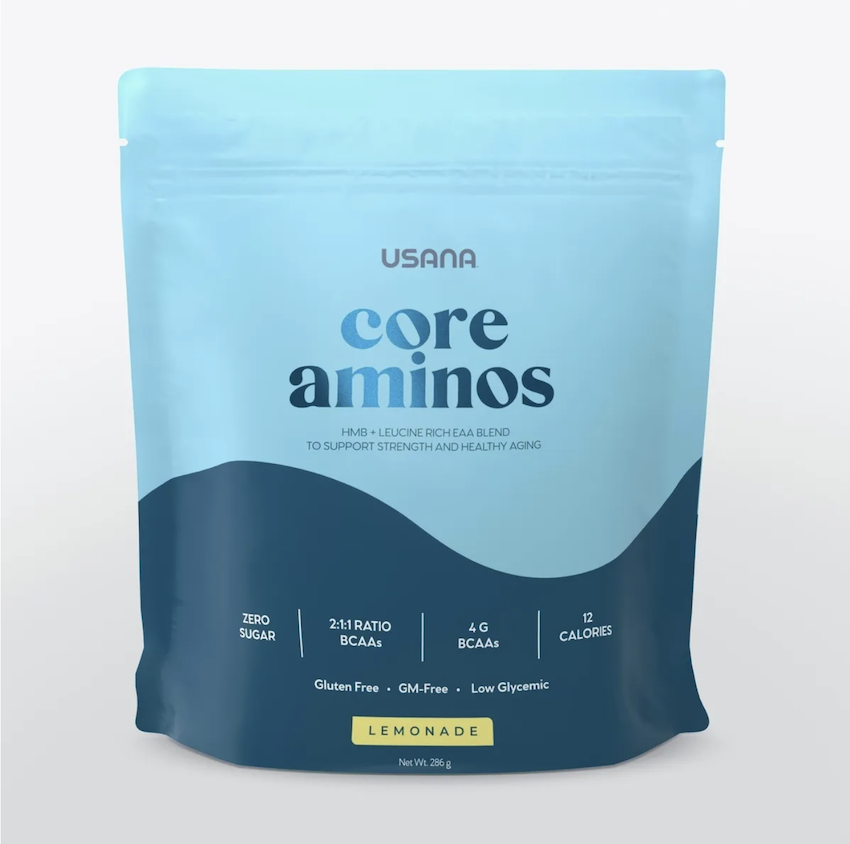
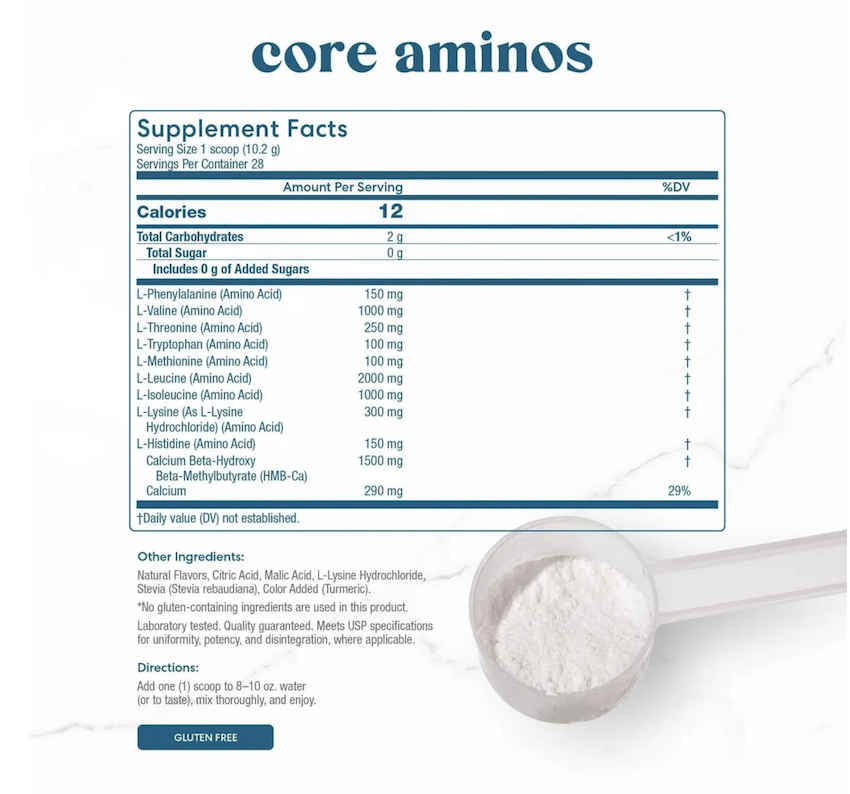
What is in Core Aminos? The ingredient label, as text
Joy Health transcribed every row below and checked it against the U.S. label USANA publishes.[1] Amounts, units, and % Daily Values are exactly as printed. Formulas change, so compare the label on your own package.
Directions on the label: Add one (1) scoop to 8–10 oz. water (or to taste), mix thoroughly, and enjoy.
| Ingredient | Amount per serving | % Daily Value |
|---|---|---|
| Calories | 12 | |
| Total Carbohydrates | 2 g | <1% |
| Total Sugar | 0 g | |
| Includes 0 g of Added Sugars | 0 g | |
| L-Phenylalanine (Amino Acid) | 150 mg | † |
| L-Valine (Amino Acid) | 1000 mg | † |
| L-Threonine (Amino Acid) | 250 mg | † |
| L-Tryptophan (Amino Acid) | 100 mg | † |
| L-Methionine (Amino Acid) | 100 mg | † |
| L-Leucine (Amino Acid) | 2000 mg | † |
| L-Isoleucine (Amino Acid) | 1000 mg | † |
| L-Lysine (As L-Lysine Hydrochloride) | 300 mg | † |
| L-Histidine (Amino Acid) | 150 mg | † |
| Calcium Beta-Hydroxy Beta-Methylbutyrate (HMB-Ca) | 1500 mg | † |
| Calcium | 290 mg | 29% |
†Daily value (DV) not established.
Other ingredients: Natural Flavors, Citric Acid, Malic Acid, L-Lysine Hydrochloride, Stevia (Stevia rebaudiana), Color Added (Turmeric).
The calcium line has a percentage error. It lists 290 mg of calcium as 29% of the Daily Value, but the Daily Value FDA uses for calcium is 1,300 mg, which makes 290 mg about 22%. 29% is what 290 mg would be against a 1,000 mg reference.[1][2]
The calcium amount is also hard to account for. NIH notes that calcium HMB is about 13% calcium by weight, which puts 1,500 mg of it near 200 mg of calcium rather than 290 mg, and the label lists no other calcium source.[1][3] We could not reconcile the figure; only USANA can explain it.
How much does Core Aminos add up to in a day?
Calcium is the only ingredient here with an adult upper limit, and one scoop is far below it. Because the label gives no number of scoops per day, the table is per scoop.
| Ingredient | Core Aminos per serving | Also in, per day | Adult UL |
|---|---|---|---|
| Calcium | 290 mg per serving |
| 2,500 mg (2,000 mg from age 51)[7]Daily intake; food alone rarely reaches it |
The label does not say how many servings to take in a day, so its amounts are per serving. Food, drinks, fortified foods, and other supplements add to these totals. A Tolerable Upper Intake Level (UL) is the highest daily intake likely to pose no risk of adverse effects for almost all healthy people in an age group. It is not a recommended intake.[6]
Is Core Aminos third-party tested?
We found no independent test record for Core Aminos. It is not among the USANA products on NSF's NSF/ANSI 173 listing as of September 23, 2026.[4] That is the absence of a record, not evidence of a problem with the product.
What to check before taking Core Aminos
- HMB over months. NIH says 3 g of HMB a day appears safe for short-term use in adults, but there is no expert consensus on its value or safety over several months or longer, and it has not been studied in adolescents.[3]
- Amino acid amounts. A scoop has 4 g of the three branched-chain amino acids (leucine, isoleucine, and valine). NIH reports that up to 20 g a day of branched-chain amino acid supplements in divided doses appears safe.[1][3]
- Sports products in general. NIH notes that supplements used for exercise can have side effects and interact with medicines, and that many combine ingredients that have not been tested together.[3]
- Protein from food. Essential amino acids also come from protein foods; the protein and fiber guide covers food sources and reference amounts.
FDA does not approve dietary supplements before they are sold, and it advises talking with a doctor, pharmacist, or other health professional before using one, because some supplements interact with medicines or other supplements.[5]
Affiliate disclosure: Joy Health may earn a commission if you buy through this link. It opens USANA's storefront, where you can check the current label and price for Core Aminos.
See Core Aminos on the USANA storeSources we read
Every source was read on September 23, 2026. Manufacturer documents are records of what the label says, not independent evidence that a product works.
- USANA, U.S. Core Aminos (Lemonade) Supplement Facts
USANA Health Sciences. The manufacturer's current U.S. label, used to check every transcribed row, the directions, and the allergen statement. A record of what the label says, not evidence that the product works. Read September 23, 2026.
- Daily Value on the Nutrition and Supplement Facts Labels
U.S. Food and Drug Administration. Used for the current calcium Daily Value of 1,300 mg. Content current as of March 5, 2024; read September 23, 2026.
- Dietary Supplements for Exercise and Athletic Performance: Fact Sheet for Health Professionals
NIH Office of Dietary Supplements. Used for what third-party certification checks, and for creatine, protein, and HMB safety notes. Read September 23, 2026.
- NSF Official Listings: USANA Health Sciences finished products under NSF/ANSI 173, Dietary Supplements
NSF. Independent certification record naming the Salt Lake City facility, 11 USANA finished products, and the manufacturer's recommended daily serving for each. A listing covers the named products, not the whole catalog. Read September 23, 2026.
- Questions and Answers on Dietary Supplements
U.S. Food and Drug Administration. Used for premarket approval and the advice to talk with a health professional because supplements can interact with medicines. Read September 23, 2026.
- Dietary Reference Intakes for Vitamin A, Vitamin K, Arsenic, Boron, Chromium, Copper, Iodine, Iron, Manganese, Molybdenum, Nickel, Silicon, Vanadium, and Zinc, Chapter 1
Institute of Medicine (National Academies Press), 2001. Used for what a Tolerable Upper Intake Level means and that it is not a recommended intake. Read September 23, 2026.
- Calcium: Fact Sheet for Health Professionals
NIH Office of Dietary Supplements. Used for the adult Tolerable Upper Intake Level and what it counts. Read September 23, 2026.
About this page
Prepared by Joy Health
Joy Health is an educational publisher, not a medical practice. The label transcription and daily totals are Joy Health's work; the upper limits come from the National Academies as reported by NIH. No external clinical reviewer participated. Joy Health earns commissions on purchases made through the storefront link on this page.
Read our editorial standards