USANA supplement label
CoQuinone 30: CoQ10 and alpha-lipoic acid per capsule
Each CoQuinone 30 capsule provides 30 mg of coenzyme Q10 and 13 mg of alpha-lipoic acid, and the label says to take one or two capsules a day, so 30 to 60 mg of CoQ10.[1] The label declares soy, and the capsule contains gelatin.[1]
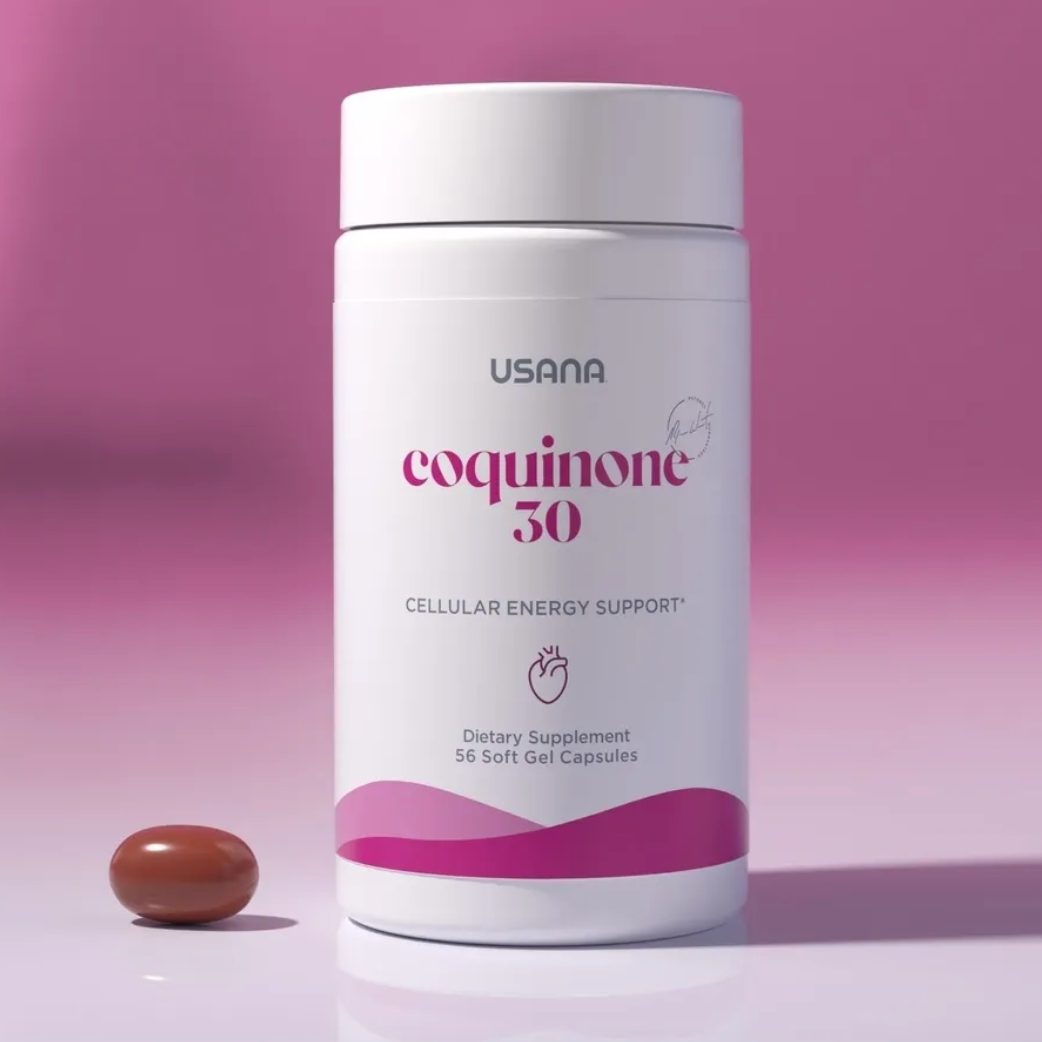
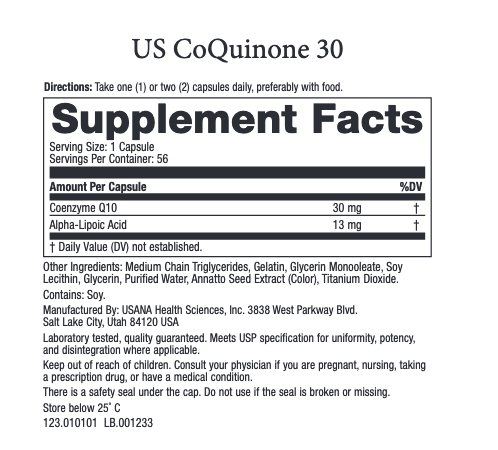
What is in CoQuinone 30? The ingredient label, as text
Joy Health transcribed every row below and checked it against the U.S. label USANA publishes.[1] Amounts, units, and % Daily Values are exactly as printed. Formulas change, so compare the label on your own package.
Directions on the label: Take one (1) or two (2) capsules daily, preferably with food.
| Ingredient | Amount per serving | % Daily Value |
|---|---|---|
| Coenzyme Q10 | 30 mg | † |
| Alpha-Lipoic Acid | 13 mg | † |
† Daily Value (DV) not established.
Other ingredients: Medium Chain Triglycerides, Gelatin, Glycerin Monooleate, Soy Lecithin, Glycerin, Purified Water, Annatto Seed Extract (Color), Titanium Dioxide.
Contains: Soy
Neither ingredient has an established Daily Value, so the label shows a dagger instead of a percentage. The label USANA links to carries item number 123.010101, while the product it sells today is 123.010102, so a newer printed label may exist. Check your package against this table.[1][2]
How much does CoQuinone 30 add up to in a day?
Neither ingredient has an upper limit, but both also appear in CellSentials and HealthPak. Two capsules a day with CellSentials, for example, comes to 72 mg of CoQ10 and 126 mg of alpha-lipoic acid. The table lists each product's daily amount so you can add up your own combination.
| Ingredient | CoQuinone 30 per day | Also in, per day | Adult UL |
|---|---|---|---|
| Coenzyme Q10 | 30–60 mg |
| No UL |
| Alpha-lipoic acid | 13–26 mg |
| No UL |
Is CoQuinone 30 third-party tested?
We found no independent test record for CoQuinone 30. It is not among the USANA products on NSF's NSF/ANSI 173 listing as of September 23, 2026.[5] That is the absence of a record, not evidence of a problem with the product.
What to check before taking CoQuinone 30
- Soy. The label says the product contains soy.[1]
- Warfarin and insulin. NIH notes that CoQ10 may interact with the blood thinner warfarin and with insulin.[3]
- Cancer treatment. NIH notes that CoQ10 may not be compatible with some types of cancer treatment.[3]
- Side effects. NIH reports no serious side effects of CoQ10, with possible mild insomnia or digestive upset. Alpha-lipoic acid may interact with other medications, and high doses can upset the stomach.[3][4]
FDA does not approve dietary supplements before they are sold, and it advises talking with a doctor, pharmacist, or other health professional before using one, because some supplements interact with medicines or other supplements.[6]
Affiliate disclosure: Joy Health may earn a commission if you buy through this link. It opens USANA's storefront, where you can check the current label and price for CoQuinone 30.
See CoQuinone 30 on the USANA storeSources we read
Every source was read on September 23, 2026. Manufacturer documents are records of what the label says, not independent evidence that a product works.
- USANA, U.S. CoQuinone 30 Supplement Facts
USANA Health Sciences. The manufacturer's current U.S. label, used to check every transcribed row, the directions, and the allergen statement. A record of what the label says, not evidence that the product works. Read September 23, 2026.
- CoQuinone 30 product data (USANA's current catalog entry)
USANA Health Sciences. The data behind USANA's product page, used for the current item number and the label it links to. Read September 23, 2026.
- Coenzyme Q10
NIH National Center for Complementary and Integrative Health. Used for interactions with warfarin, insulin, and some cancer treatments, and for reported side effects. Limitation: last updated January 2019. Read September 23, 2026.
- Type 2 Diabetes and Dietary Supplements: What the Science Says
NIH National Center for Complementary and Integrative Health. Clinical digest used for alpha-lipoic acid safety and the note that it may interact with other medications; it names no specific drug. Read September 23, 2026.
- NSF Official Listings: USANA Health Sciences finished products under NSF/ANSI 173, Dietary Supplements
NSF. Independent certification record naming the Salt Lake City facility, 11 USANA finished products, and the manufacturer's recommended daily serving for each. A listing covers the named products, not the whole catalog. Read September 23, 2026.
- Questions and Answers on Dietary Supplements
U.S. Food and Drug Administration. Used for premarket approval and the advice to talk with a health professional because supplements can interact with medicines. Read September 23, 2026.
About this page
Prepared by Joy Health
Joy Health is an educational publisher, not a medical practice. The label transcription and daily totals are Joy Health's work; the upper limits come from the National Academies as reported by NIH. No external clinical reviewer participated. Joy Health earns commissions on purchases made through the storefront link on this page.
Read our editorial standards